“Liberia Line” … 10 December 1928 ‑ 6 March 1929
off Cape St. Vincent — 19 December 1928
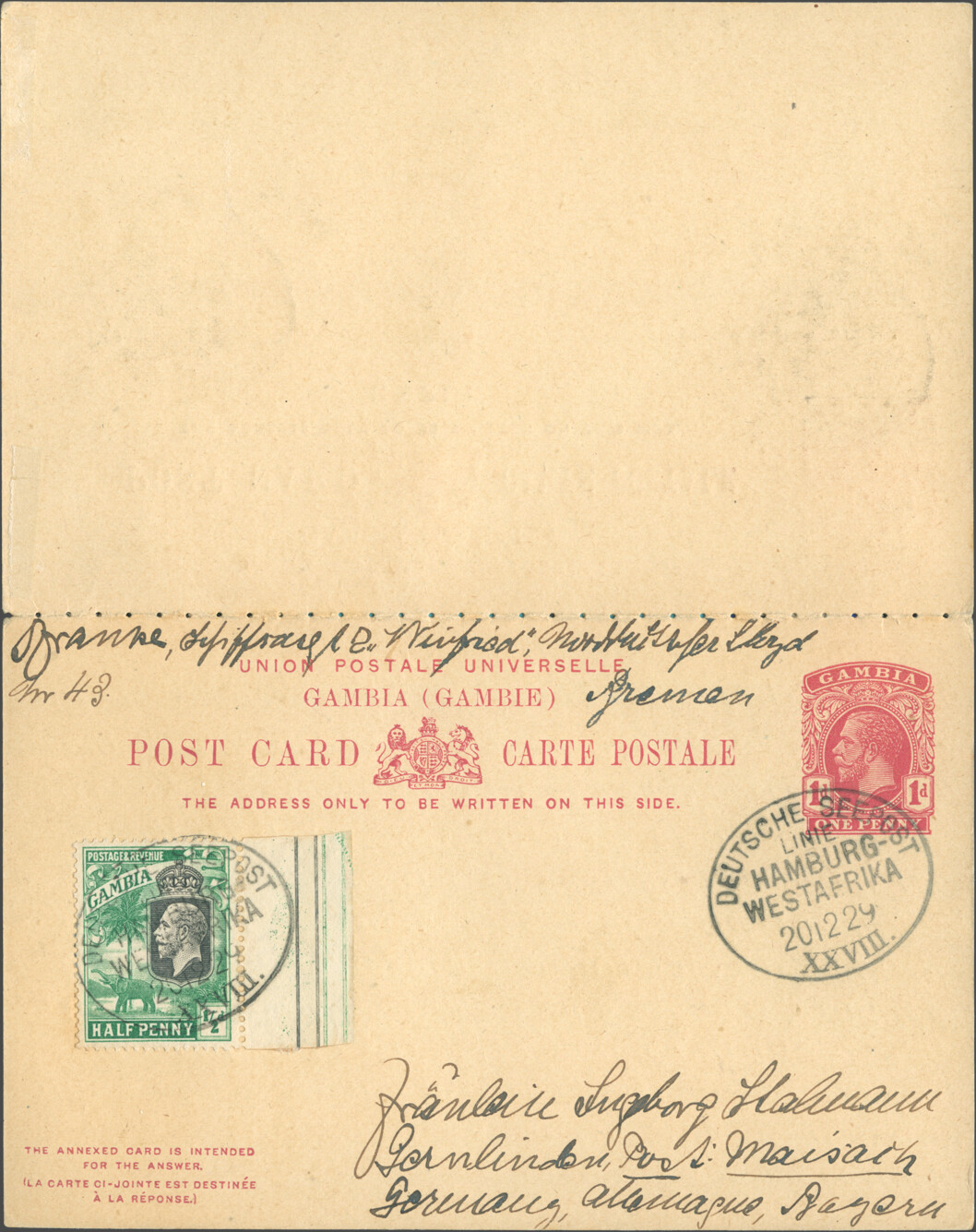
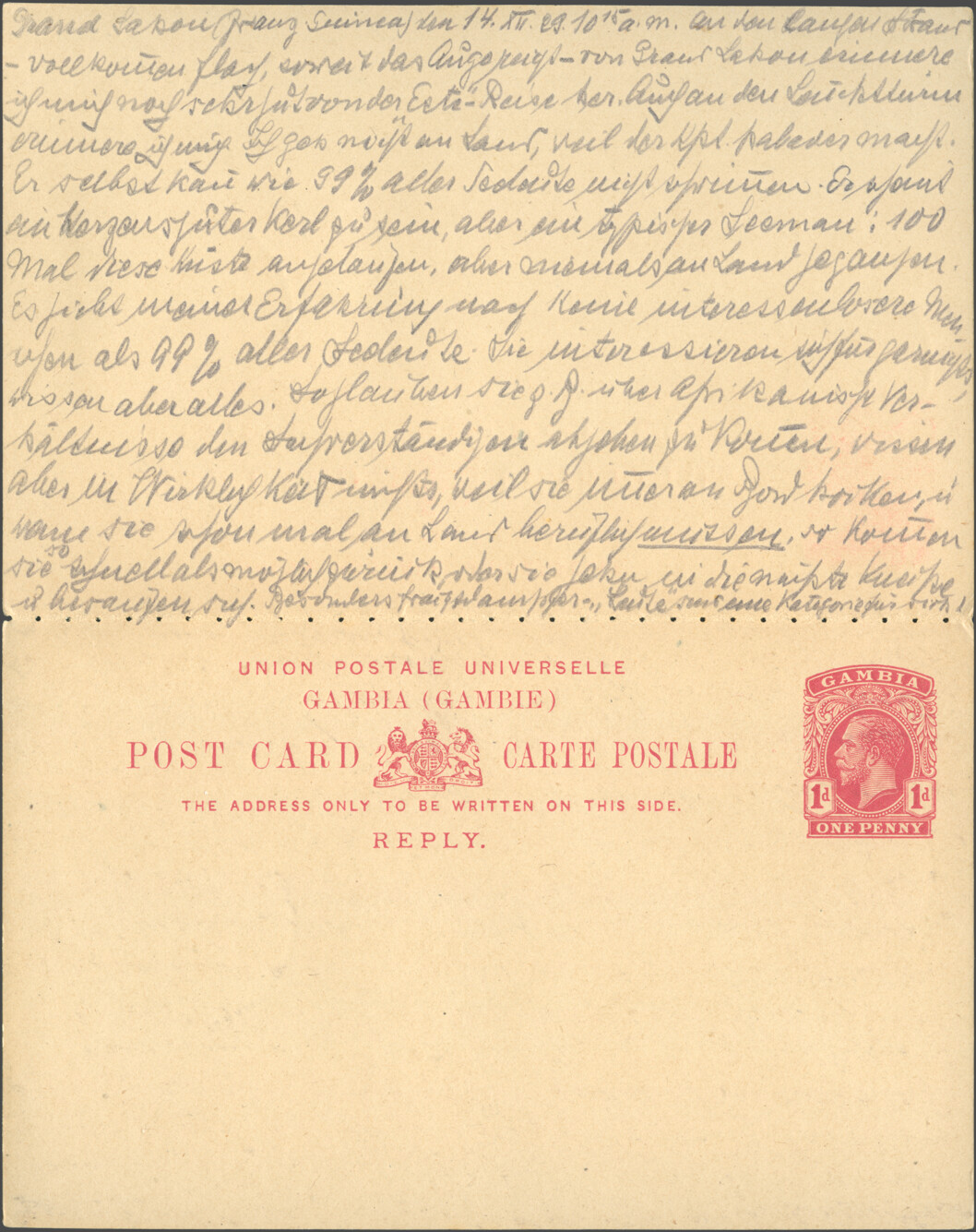
German 8 pfennigs double card with additional German 10 pfennigs airmail stamp cancelled SEEPOST 21 December 1928, arrived in Maisach on 2 January 1929.

Transcript
              Franke, Schiffsarzt
              D„Este“, Woermann-
                  Linie, Hamburg
Auf der Höhe von Kap St.
Vincent, den 19/XII-28. 4 h p.m.
    Das Feuer von St. Vincent wird
von den Schiffen angesteuert, die
durch die Straße von Gibraltar fah-
ren wollen. Ich sah es zum ersten
male im Sommer 1899, als ich mit
„Serbia“ von der Hamburg-Amerika
Linie, früher der Kingsin-Linie ge-
hörig, meine erse Reise nach Ost-
Asien (bis Japan) machte. Ich erinnere
mich noch, als wenn es heute morgen
gewesen wäre, es war morgens gegen 5 Uhr. Zum letzten male habe
ich den Leuchtturm gesehn, als ich mit dem Motorschiff „Münsterland“,
ebenfalls von der Hapag, im Herbst 1927 wieder nach Ostasien fuhr — diesmal
bis Japan u. Dairen (Dalny). Nichts erinnerte mich mehr an meine erste
Fahrt vor fast 30 Jahren, außer Hongkong u. die auf dem Poloplatz
stehende Kirche von Singapore. 1899 sah ich hier Fußball spielende eng-
lische Soldaten, 1927 bez. 1928 Rugby spielende englische Zivilisten. Dann
bin ich 1908 mit „Windhuk“ (Reichspostdampfer der Hapag, die schönste
Reise meines Lebens, um Afrika) u. mit Hapagdampfer „Tanganjika“
1923 (ebenfalls Rückfahrt um Afrika) durch die Straße von Gibraltar, dem
Kap Spartel gegenüber liegt (die Herkulessäulen der alten Römer?), ge-
fahren. Diesmal haben wir Kap St. Vincent in 180 Seemeilen Abstand
passiert, sodaß davon nichts zu sehen war. Seidem wir den „Preußischen
Grenadier“ = Leuchtturm von Ouessant passiert haben, haben wir bis
heute kein Land u. nur ein Segelschiff gesehen, da Kpt. Thiel, als Sicherheits-
Kommissarius, Kap Finisterre in 60 Meilen Abstand angesteuert hat. Wetter
ganz großartig im Gegensatz zu meinen Reisen mit „Teutonia“, „Galicia“ u. „Tsad“. Fr
Translation
Franke, ship’s doctor SS “Este,” Woermann Line, HamburgAt the level of Cape St. Vincent, 19 December 1928, 4 p.m.
The lighthouse of St. Vincent is headed for by ships that want to sail through the Strait of Gibraltar. I first saw it in the summer of 1899, when I made my first voyage to East Asia (as far as Japan) on board the “Serbia” of the Hamburg-America Line, previously belonging to the Kingsin Line. I still remember it as if it were this morning, it was around 5 a.m. The last time I saw the lighthouse was in the autumn of 1927, when I sailed to East Asia again on the motor ship “Münsterland,” also owned by Hapag — this time to Japan and Dairen (Dalny) [today Dalian]. Nothing reminded me of my first trip almost 30 years earlier, except for Hong Kong and the church on the polo grounds in Singapore. In 1899, I saw English soldiers playing football here, and in 1927 and 1928, I saw English civilians playing rugby. Then, in 1908, I sailed on the “Windhoek” (Hapag’s Imperial Mail steamer, the most beautiful voyage of my life, around Africa) and in 1923 on the Hapag steamer “Tanganjika” (also a return voyage around Africa) through the Strait of Gibraltar, opposite Cape Spartel (the Pillars of Hercules of the ancient Romans?). This time we passed Cape St. Vincent at a distance of 180 nautical miles, so there was no sign of it. Since we passed the “Prussian Grenadier” = the lighthouse of Ouessant, we haven’t seen any land and only one sailing ship, as Captain Thiel, as the safety commissioner, headed for Cape Finisterre at a distance of 60 miles. Absolutely magnificent weather, in contrast to my voyages on the “Teutonia,” “Galicia,” and “Tsad.” Fr
The German term “Sicherheits-Kommissarius” (safety commissioner) in connection with Captain Thiel’s decision to pass Cape Finisterre at a distance of 60 miles has an almost humorous or even sarcastic ring to it, especially since it is hardly necessary to emphasize the captain’s responsibility for the ship’s safety — that goes without saying.
One possible explanation for Franke’s mockery of what he may have perceived as an overly cautious measure could be an incident that occurred while the ship was still in the port of Hamburg.
The Este, initially under the command of Captain Gruner, departed as scheduled on 10 December 1928.
She did not get far, though.
According to a note in the Hamburger Echo on 11 December, “On Monday afternoon, the coastal steamer ‘Este’ collided with a group of dolphins at the pontoon in front of the [pier] ‘Sandtorhöft.’ While manoeuvring, the steamer was pushed against the piles by the prevailing river current, causing some of them to buckle and others to break off. The ship itself suffered no significant damage. The group of damaged pilings is marked by a red flag.”[1]
For your peace of mind, “A dolphin is a group of pilings arrayed together to serve variously as a protective hardpoint along a dock, in a waterway, or along a shore.” (Wikipedia).
Allowing a departing ship to collide with some nearby dolphins must be a sailor’s equivalent of driving a truck from a parking lot straight into the nearest fence.
Either Captain Gruner immediately changed his name out of embarrassment or, more likely, he was replaced after this demonstration of his skills.
Since the ship was not damaged, the collision only caused a delay of one day.
However, it may have prompted the new man at the helm to be extra cautious.
Rio de Oro — 25 December 1928
Spain 15 céntimos postal card with additional Spanish stamps (10 céntimos) postmarked SEEPOST 26 December 1928, arrived in Maisach on 15 January.

Transcript
Querab vom Vorgebirge Virginia (Kap Barbar u. Kap Corveiro)
Rio de Oro = Spanisch Sahara, 25. Dezember 1928. 9 h a.m.
    Ich habe selten eine so nette Weihnachts-
feier wie gestern abend verlebt. Ein Passagier
hat mir 100 kubanische Cigarretten geschenkt.
Wir hatten einen niedlichen Christbaum,
der Salon war geschmackvoll dekoriert und drei
Kapellen: 2 Grammophone u. 1 Harmonium,
es wurde flott getanzt - woran ich mich
allerdings nicht beteiligt habe. Franke
Translation
Abeam of the Virginia foreland (Cape Barbar and Cape Corveiro)Rio de Oro = Spanish Sahara, 25 December 1928, 9 a.m.
I have rarely experienced such a nice Christmas party as last night. A passenger gave me 100 Cuban cigarettes. We had a cute Christmas tree, the salon was tastefully decorated, and three bands: two gramophones and one harmonium, there was lively dancing – which I, however, didn’t join. Franke
Senegal — 25 December 1928
Spain 15 céntimos postal card with additional Spanish stamps (12 céntimos) postmarked SEEPOST 26 December 1928, arrived in Maisach on 15 January.

Transcript
Auf der Höhe von St. Louis am Senegal, den 25.XII.28, 7 h p.m.
Es ist jammerschade, daß die Franzosen, Spanier
und Portugiesen einen so gewaltigen Kolonial-
besitz in Afrika haben. Die Franzosen haben kei-
ne Leute zum Kolonisieren, auch sind sie wie alle
Lateiner schlampig, die Spanier taugen noch
weniger, und die Portugiesen, diese halbweißen
Nigger, sind das schlimmste Gesindel auf Erden.
Wie oft bin ich in spanischen und portugiesischen
Kolonien gewesen! Ach!! Wäre Wilhelm II, der Gerne-
groß, nicht in den Weltkrieg hineingetaumelt, so hätte
Deutschland ein Teil der portugiesischen Kolonien gekauft. Fr.
Translation
At the level of St. Louis at Senegal, 25 December 1928, 7 p.m.It’s a crying shame that the French, Spanish, and Portuguese have such vast colonial possessions in Africa. The French have no people to do the colonizing, and like all Latins, they are sloppy, the Spanish are even worse, and the Portuguese, those half-white niggers, are the worst scum on earth. How often I've been to Spanish and Portuguese colonies! Alas!! If Wilhelm II, that cockalorum, hadn’t stumbled into the World War, Germany would have bought part of the Portuguese colonies. Fr.
Dakar — 28 December 1928
Envelope franked with French Senegalese stamps (2 francs) cancelled and registered in Dakar on 28 December 1928, arrived in Maisach on 9 January 1929.

Sherbro — 6 January 1929
Sierra Leone 1½ pence postal card postmarked SEEPOST 11 January 1929, with additional Liberian stamps (13 cents) cancelled and registered in Buchanan on 14 January, arrived in Maisach on 4 February.The date of the Buchanan handstamp used to cancel this and other covers is useless and probably hadn’t been changed for quite a while. However, according to a later Franke postcard, the date the “Este” visited Buchanan was the 14th of January.

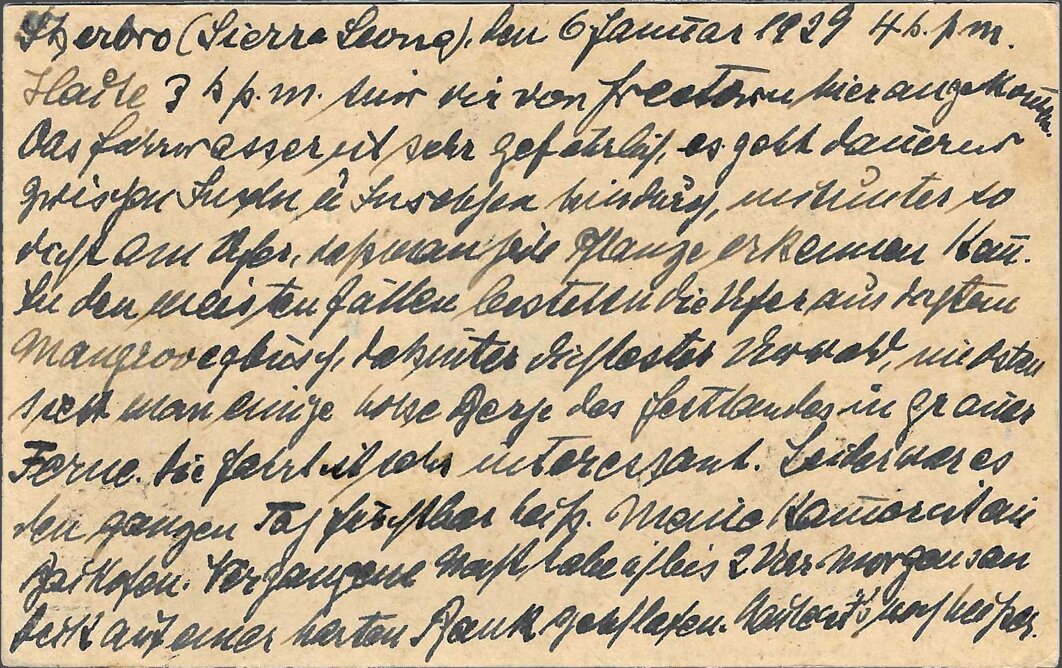
Transcript
Sherbro (Sierra Leone), den 6. Januar 1929 4 h p.m.
Heute 3 h p.m. sind wir von Freetown hier angekommen.
Das Fahrwasser ist sehr gefährlich, es geht dauernd
zwischen Inseln u. Inselchen hindurch, mitunter so
dicht am Ufer, daß man jede Pflanze erkennen kann.
In den meisten Fällen bestehen die Ufer aus dichtem
Mangrovengebüsch, dahinter dichtester Urwald, im Osten
sieht man einige hohe Berge des Festlandes in grauer
Ferne. Die Fahrt ist sehr interessant. Leider war es
den ganzen Tag furchtbar heiß. Meine Kammer ist ein
Backofen. Vergangene Nacht habe ich bis 2 Uhr morgens an
Deck auf einer harten Bank geschlafen. Heute ist’s noch heißer.
Translation
Sherbro (Sierra Leone), 6 January 1929 4 p.m.We arrived here from Freetown at 3 p.m today. The fairway is very dangerous, constantly passing between islands and islets, sometimes so close to the shore that you can see every plant. For the most part, the shores consist of dense mangrove shrubs, behind them the thickest jungle, to the east you can see some high mountains of the mainland in the grey distance. The trip is very interesting. Unfortunately, it was terribly hot all day. My cabin is an oven. Last night I slept on deck on a hard bench until 2 a.m. Today it’s even hotter.
Sherbro — 6 January 1929
Sierra Leone 1½ pence postal card postmarked SEEPOST 11 January 1929, with additional Liberian 5 cents stamp cancelled and registered in Rivercess in January (day unreadable), arrived in Maisach on 25 February.

Transcript
Sherbro (Sierra Leone), den 6. Januar 1929, 6 p.m.
Es wird finster. An Land bin ich nicht gewesen, da ich 45
Minuten mit unserer Dampfpinasse hätten fahren
müssen, so weit ab liegen wir von Sherbro, da das
Wasser für unsere „Este“ zu wenig tief ist. Es wäre eine
herrliche Tropennacht, wenn es weniger heiß wäre. Trotz-
dem ist es schön, auf dem absolut ruhigen Wasser
zu liegen, allen Komfort zur Verfügung, umgeben
vom Urwalde Afrikas. Langsam verschwinden
die Ufer der vielen Inseln im Dunkeln, nirgends
ein Licht zu sehen, da Sherbro hinter einer Landzunge ver-
borgen ist.
Translation
Sherbro (Sierra Leone), 6 January 1929, 6 p.m.It is getting dark. I was not on land because I would have had to travel 45 minutes on our steam pinnace, we are that far away from Sherbro because the water isn’t deep enough for our “Este.” It would be a lovely tropical night if it were less hot. Nevertheless, it is nice to lie on the absolutely calm water, with all comforts at your disposal, surrounded by the African jungle. Slowly the shores of the many islands disappear into darkness, with no light anywhere to be seen as Sherbro is hidden behind a headland.
Written on 6 January, Dr. Franke only handed this postcard over to the purser five days later, on 11 January – apparently too late to be passed on to a post office in Sierra Leone. It seems it was not handed back to him immediately, because the ship had already passed several ports in Liberia when the card, now supplemented with a Liberian 5c stamp (on top of the SEEPOST cancel), was posted registered in Rivercess. Apparently, the local postal clerk accepted cash as payment for registration.
abeam of Banana Island → Sulima — 7 January 1929
Sierra Leone 1½ pence postal card postmarked SEEPOST 11 January 1929, with additional Liberian 5 cents stamp cancelled and registered in Rivercess on 28 January, arrived in Maisach on 25 February.
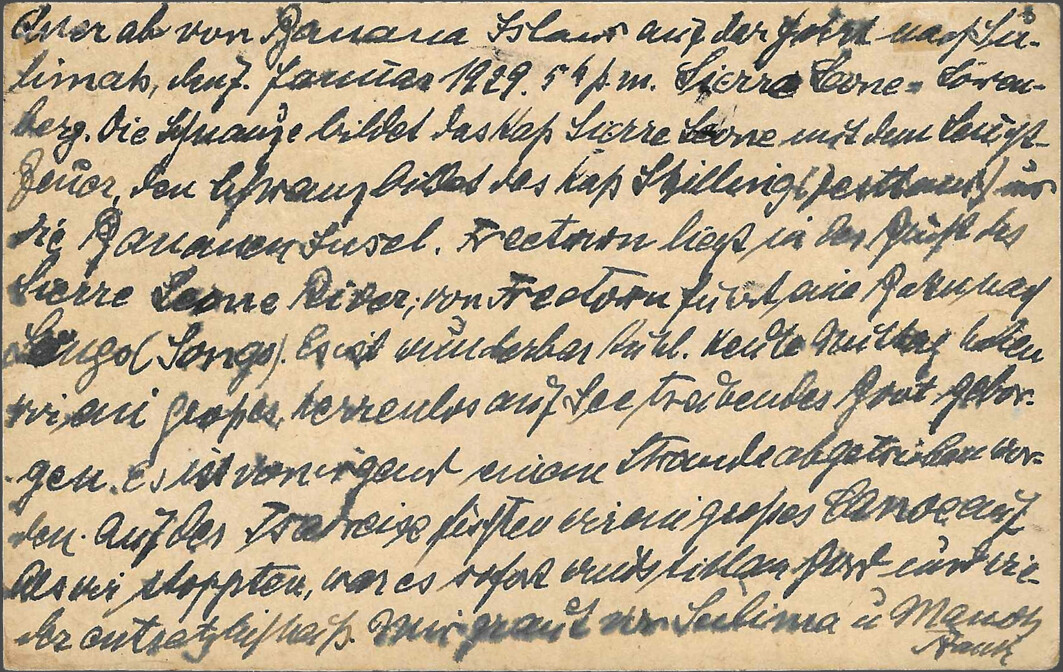
Transcript
Quer ab von Banana Island auf der Fahrt nach Su-
limah, den 7. Januar 1929. 5 h p.m. Sierra Leone = Löwen-
berg. Die Schnauze bildet das Kap Shilling (Festland) und
die Bananen Insel. Freetown liegt in der Bucht des
Sierre Leone River; von Freetown führt eine Bahn nach
Songo (Songs). Es ist wunderbar kühl. Heute Mittag haben
wir ein großes, herrenlos auf See treibendes Boot gebor-
gen. Es ist von irgend einem Strande abgetrieben wor-
den. Auf der Tsadreise fischten wir ein großes Canoe auf.
Als wir stoppten, war es sofort windstill an Bord und wie-
der entsetzlich heiß. Mir graut vor Sulima u. Manoh
                                                      Franke
Translation
Abeam of Banana Island on the way to Sulima, 7 January 1929. 5 p.m.Sierra Leone = Lion Mountain. The snout is formed by Cape Shilling (mainland) and Banana Island. Freetown lies in the bay of the Sierra Leone River; a railway runs from Freetown to Songo (Songs). It is wonderfully cool. This afternoon we salvaged a large abandoned boat that was drifting at sea. It had drifted off some beach. On the Tsad journey, we fished up a large canoe. When we stopped, it immediately became windless on board and terribly hot again. I am dreading Sulima and Mano. Franke
off Shebar Entrance — 8 January 1929
Sierra Leone 1½ pence postal card postmarked SEEPOST 11 January 1929, with additional Liberian stamps (15 cents) cancelled and registered in Buchanan on 14 January, arrived in Maisach in February.

Transcript
8/I-29. 11 h a.m. Heute Morgen bei Sonnenaufgang waren wir
querab von Shebar Entrance, dem südlichen Zugang
von She[r]bro, welcher für die „Este“ nicht passierbar ist, weshalb wir
von She[r]bro (fast) bis Kap Sierra Leone zurückmussten.
Seitdem wir wieder auf dem offenen Meere sind, haben
wir wieder kühles, angenehmes Wetter. Ich habe von 10–6 a.m.
diese Nacht herrlich geschlafen, da wir frische Brise von
Backbord, wo meine Kammer liegt, hatten. Eine Stunde im
Bad gelegen. Jetzt fahren wir entlang der Turner Peninsula,
was eigentlich eine lange Insel ist. Küste ganz flach mit
wunderbarem Sandstrande, welcher bis Kap Mount an-
halten wird. Sulima liegt am Sulimafluß auf einer Land-
zunge. Mano, am Mano=Manna-River gelegen, ist auf den engl.
Seekarten noch als Woermanns Factory bezeichnet. Monrovia liegt [am?]
                                                              St. Paul-River. Fr
Translation
8 January 1929, 11 a.m.This morning at sunrise we were abreast of Shebar Entrance, the southern entrance to She[r]bro, which is not passable for the “Este,” which is why we had to go back from She[r]bro (almost) to Cape Sierra Leone. Since we are back on the open sea, we have cool, pleasant weather again. I had a lovely night’s sleep from 10–6 a.m. as we had a fresh breeze from the port side where my cabin is. Lay in the bath for an hour. Now we’re sailing along the Turner Peninsula, which is actually a long island. The coast is completely flat with a wonderful sandy beach that extends all the way to Cape Mount. Sulima is located on a headland on the Sulima River. Mano, located on the Mano=Manna River, is still referred to as Woermann’s Factory on English nautical charts. Monrovia is located [on?] St. Paul River. Fr
Sulima — 9 January 1929
Sierra Leone 1½ pence postal card postmarked SEEPOST 11 January 1929, with additional Liberian stamps (15 cents) cancelled and registered in Buchanan on 14 January, arrived in Maisach on 4 February.
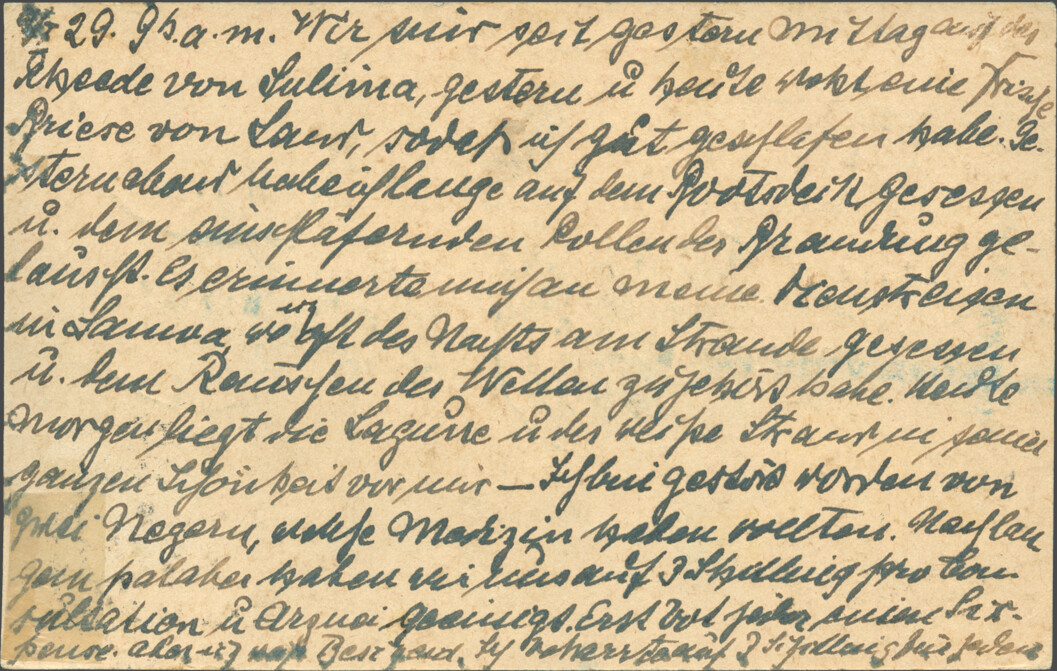
Transcript
9/I 29. 9 h a.m. Wir sind seit gestern mittag auf der
Rheede von Sulima, gestern u. heute weht eine frische
Briese von Land, sodaß ich gut geschlafen habe. Ge-
stern abend habe ich lange auf dem Bootsdeck gesessen
u. dem einschläfernden Rollen der Brandung ge-
lauscht. Es erinnerte mich an meine Dienstreisen
in Samoa, wo ich of des Nachts am Strande gesessen
u. dem Rauschen der Wellen zugehört habe. Heute
morgen liegt die Lagune u. der weiße Strand in seiner
ganzen Schönheit vor mir – Ich bin gestört worden von
zwei Negern, welche Medizin haben wollten. Nach lan-
gem Palaber haben wir uns auf 3 Schilling pro Con-
sultation u. Arznei geeinigt. Erst bot jeder einen Six-
pence, aber ich wußte Bescheid. Ich beharrte auf 3 Schilling für jeden.
Translation
9 January 1929, 9 a.m.We have been in the roadstead of Sulima since yesterday afternoon. Yesterday and today, a fresh breeze has been blowing from the land, so I slept well. Last night, I sat for a long time on the boat deck, listening to the lulling roar of the surf. It reminded me of my official journeys to Samoa, where I often sat on the beach at night and listened to the sound of the waves. This morning, the lagoon and the white beach lie before me in all their beauty. – I was interrupted by two Negroes who wanted medicine. After much discussion, we agreed on 3 shillings per consultation and medicine. At first, each of them offered a sixpence, but I knew the score. I insisted on 3 shillings each.
Mano-Salija — 9 January 1929
Sierra Leone 1½ pence postal card postmarked SEEPOST 13 January 1929, with additional Liberian stamps (15 cents) cancelled and registered in Buchanan on 14 January, arrived in Maisach on 4 February.

Transcript
Auf der Rheede von Mano-Silaja [Salija!], 9/I-29. 5 h p.m. Heute war ich an
Land. Die Fahrt mit dem Boot vom Schiff nach der „Stadt“, be-
stehend aus einer deutschen Faktorei (West-Hamburg)
mit einem Deutschen u. einer englischen Faktorei ([Jettson?]
and Co.) mit einem Engländer, einem schwarzen Zollbe-
amten, welcher gleichzeitig Postmeister ist, und etwa 30
aus einer Art Beton gebauten Negerhütten mit trockenen
Palmenblätterdach - die Straßen sind peinlichst sauber
gehalten (englische Kolonie Sierra Leone) - also man
fährt eine halbe [?] vom Schiff durch die Brandung in die
Langune, in welche der Mano mündet, welcher die Grenze zwi-
schen Sierra Leone u. Liberia bildet. Die Fahrt ist gefährlich. Fr.
Translation
In the roadstead of Mano-Silaja [sic: read Mano-Salija], 9 January 1929. 5 p.m.Today I was ashore. The boat trip from the ship to the “town,” consisting of a German trading post (West Hamburg) with one German and an English trading post ([Jettson?] and Co.) with one Englishman, a Black customs officer who is also the postmaster, and about 30 Negro huts made of some kind of concrete with dry palm leaf roofs — the streets are kept meticulously clean (English colony of Sierra Leone) — so you travel half a [?] from the ship through the surf into the lagoon, into which the Mano River flows, which forms the border between Sierra Leone and Liberia. The trip is dangerous.
Mano — 10 January 1929
Sierra Leone 1½ pence postal card postmarked SEEPOST 11 January 1929, with additional Liberian stamps (15 cents) cancelled and registered in Buchanan on 14 January, arrived in Maisach on 4 February.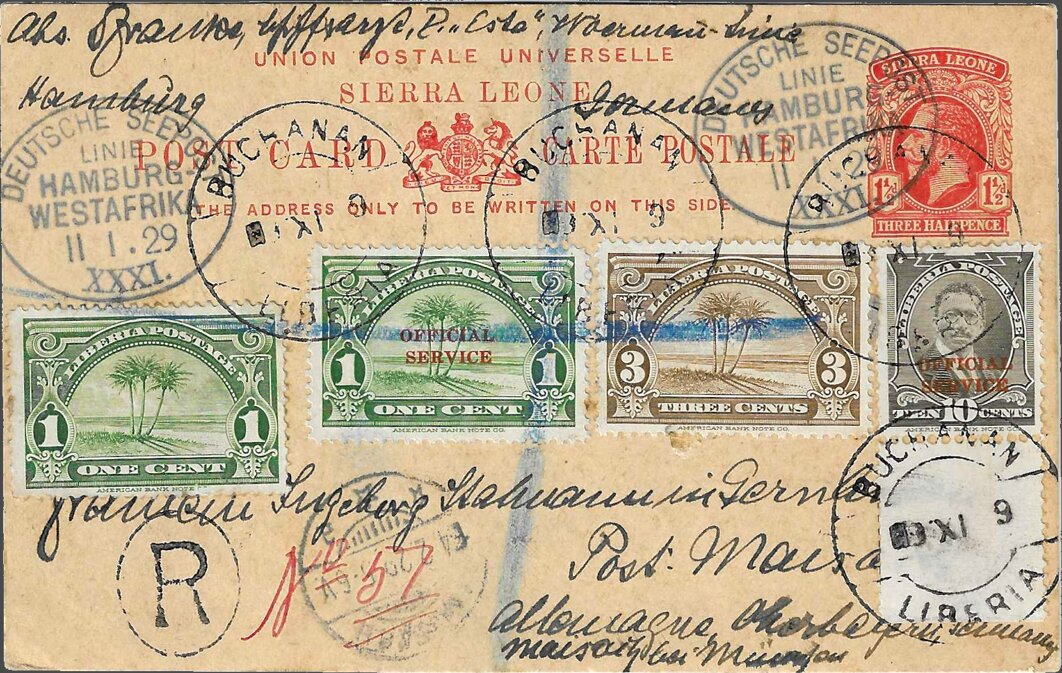
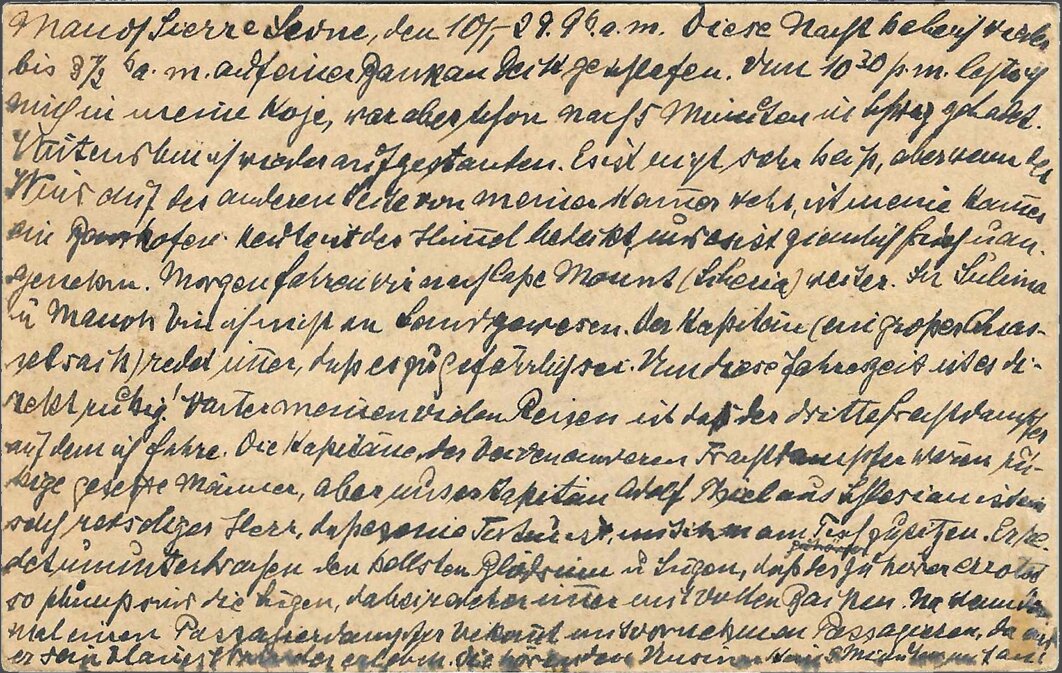
Transcript
Mano/Sierra Leone, den 10/I-29. 9 h a.m. Diese Nacht habe ich wieder
bis 3 1/2 h a.m. auf einer Bank an Deck geschlafen. Um 10:30 p.m. legte ich
mich in meine Koje, war aber schon nach 6 Minuten in Schweiß gebadet.
Wütend bin ich wieder aufgestanden. Es ist nicht sehr heiß, aber wenn der
Wind auf der anderen Seite von meiner Kammer weht, ist meine Kammer
ein B[ack?]ofen. Heute ist der Himmel bedeckt, und es ist ziemlich frisch u. an-
genehm. Morgen fahren wir nach Cape Mount (Liberia) weiter. In Sulima
u. Mano bin ich nicht an Land gewesen. Der Kapitän (ein großer Quas-
selsack) redet immer, daß es zu gefährlich sei. Um diese Jahreszeit ist es di-
rekt ruhig! Unter meinen vielen Reise ist das der dritte Frachtdampfer
auf dem ich fahre. Die Kapitäne der beiden anderen Frachtdampfer waren ru-
hige gesetzte Männer, aber unser Kapitän Adolf Thiel aus Schlesien ist ein
solch redseliger Herr, daß es eine Tortur ist, mit ihm am Tisch zu sitzen. Er re-
det ununterbrochen den dollsten Blödsinn u. Lügen, daß der Zuhörer errötet,
so plump sind die Lügen, dabei redet er immer mit vollen Backen. Na wenn der
mal einen Passagierdampfer bekommt mit vornehmen Passagieren, da wird
er sein blaues Wunder erleben, die hören den Unsinn keine 5 Minuten mit an!
Translation
Mano/Sierra Leone, 10 January 1929, 9 a.m.This night I slept again on a bench on deck until 3:30 p.m. At 10:30 p.m. I lay down in my bunk, but after only six minutes I was soaked in sweat. I got up angry. It’s not very hot, but when the wind blows on the other side from my cabin, it’s an oven. Today the sky is overcast, and it’s quite cool and pleasant. Tomorrow we will continue to Cape Mount (Liberia). I didn’t go ashore in Sulima or Mano. The captain (a big chatterbox) keeps saying it’s too dangerous. It is positively calm at this time of the year! Among my many journeys, this is the third cargo ship I have sailed on. The captains of the other two cargo steamers were quiet, earnest men, but our Captain Adolf Thiel from Silesia is such a loquacious man that sitting at a table with him is torture. He talks non-stop, the most ridiculous nonsense and lies that make the listener blush, so crude are the lies, and he always talks with a full mouth. Well, if he ever gets a passenger steamer with distinguished passengers, he will be in for a big surprise, they won’t listen to this nonsense for 5 minutes!
Robertsport — 11 January 1929
Envelopes franked with Liberian stamps (15 cents) cancelled and registered in Robertsport on 11 January 1929, arrived in Maisach on 7 February.


Monrovia — 12 January 1929
Envelope franked with Liberian stamps (24 cents) cancelled and registered in Monrovia on 12 January 1929, arrived in Maisach on 4 February.

Monrovia → Junk — 12 January 1929
Sierra Leone ½ penny postal card postmarked SEEPOST 13 January 1929, with additional Liberian stamps (13 cents) cancelled and registered in Buchanan on 14 January, arrived in Maisach on 4 February.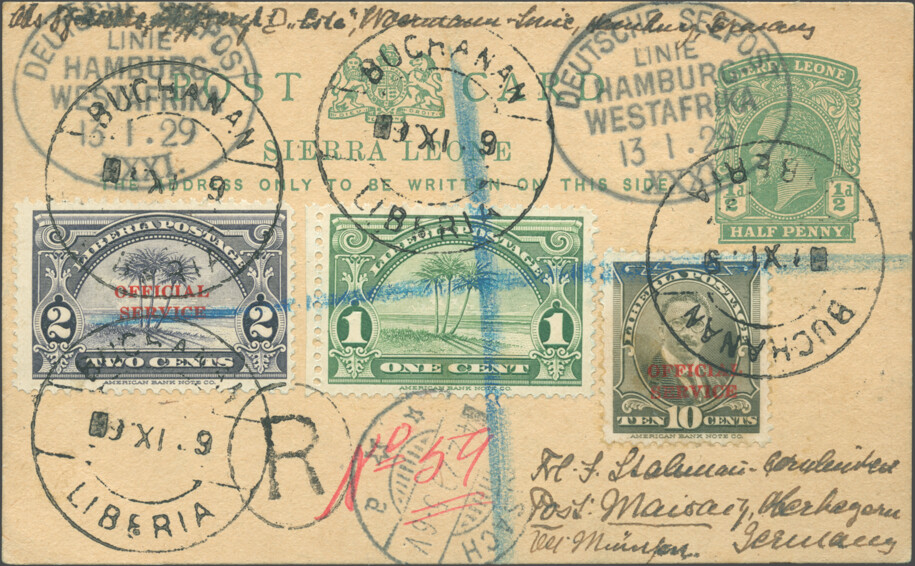

Transcript
Auf der Fahrt von Monrovia nach Junk (Liberia), 12/I-29. 3 h p.m.
Heute morgen 6 h sind wir von Cape Mount (Robertsport) hier angekommen.
Ich bin um 9 h a.m. mit der Agentur-Pinasse an Land gefahren. Monrovia
ist dreckig, das Volk das frechste, was ich bis jetzt gesehen habe. Der Weiße an Land
muß nach jeder Richtung buckeln u. schwenzeln. Der Neger läßt ihn fühlen,
daß er der Herr ist. Deck u. Salon wimmelt von schwarzen Passagieren.
Diese Schweine beißen überall den Herrn raus. Es ist jetzt noch viel schlimmer
als 1922, als ich mit „Tsad“ von Hapag hier war. Ich werde von jetzt ab jeden Neger,
dem ich in Deutschland begegne, anspucken. Ich habe auf dieser Reise Scenen
von Anmaßung, Feigheit u. Gemeinheit von Negern gesehen, daß ich tief er-
schüttert bin. Ueberall wird man betrogen (auf der Post!!) u. bestohlen (an
Bord!) Dem leitenden Ingenieur hat man 3 £ aus der Kammer gestohlen, mir
hat man, waehrend ich in meiner Kammer einen Neger verband, den Nagelreiniger
u. die Zahnpasta gestohlen. Es ist furchtbar an Bord, mit Worten garnicht zu
schildern. Unser Salon I. Klasse sieht aus wie ein Schweinestall. Ich habe mir
in Monrovia das deutsche Konsulat u. den Palast des Praesidenten von außen ange-
sehn. Auch die dreckige Negerstadt an der Küste besichtigt u. den stinkenden Markt.
Ich gehe noch einmal in Liberia an Land, um die Post aufzugeben, dann nie wieder. Fr.
Translation
On the way from Monrovia to Junk (Liberia), 12 January 1929, 3 p.m.We arrived here this morning at 6 a.m. from Cape Mount (Robertsport). I went ashore at 9 a.m. on the agency’s pinnace. Monrovia is filthy, the people the most impudent I have ever seen. The white man ashore has to kowtow and wag his tail in every direction. The Negro makes him feel that he’s the boss. The deck and lounge are teeming with Black passengers. These bastards are playing the boss everywhere. It’s much worse now than in 1922, when I was here with the “Tsad” from Hapag. From now on, I will spit at every Negro I meet in Germany. I have seen scenes of arrogance, cowardice, and meanness on the part of Negroes on this voyage that I am deeply shocked. You get cheated everywhere (at the post office!!) and robbed (on board!). The chief engineer had 3 pounds stolen from his cabin, and while I was bandaging a Negro in my cabin, my nail cleaner and toothpaste were stolen. It’s horrible on board, beyond words. Our first class lounge looks like a pigsty. In Monrovia, I inspected the German consulate and the president’s palace from the outside. I also visited the filthy Negro town on the coast and the stinking market. I will go ashore in Liberia one more time to post the mail, then never again.
Junk — 12 January 1929
Sierra Leone ½ penny postal card postmarked SEEPOST 13 January 1929, with additional Liberian stamps (13 cents) cancelled and registered in Buchanan on 14 January, arrived in Maisach on 4 February.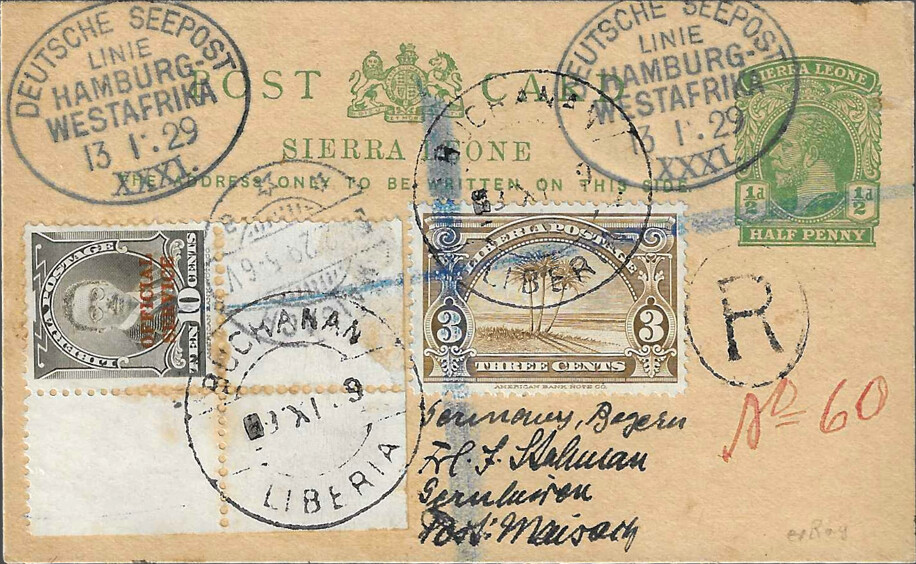
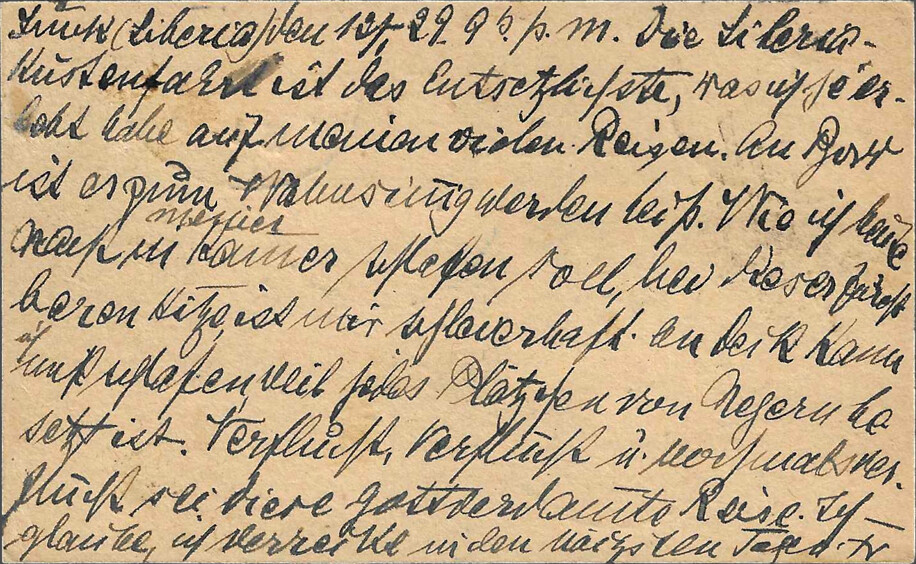
Transcript
Junk (Liberia) den 12/I-29. 9 h p.m. Die Liberia-
Küstenfahrt ist das Entsetzlichste, was ich je er-
lebt habe auf meinen vielen Reisen. An Bord
ist es zum wahnsinnig werden heiß. Wie ich heute
Nacht in meiner Kammer schlafen soll, bei dieser furcht-
baren Hitze, ist mir schleierhaft. An Deck kann
ich nicht schlafen, weil jedes Plätzchen von Negern be-
setzt ist. Verflucht, verflucht u. nochmals ver-
flucht sei diese gottverdammte Reise. Ich
glaube, ich verrecke in den nächsten Tagen. Fr.
Translation
Junk (Liberia), 12 January 1929, 9 p.m.The Liberia coast trip is the most horrific thing I have ever experienced on my many voyages. It’s incredibly hot on board. How I am supposed to sleep in my cabin tonight in this terrible heat is beyond me. I can’t sleep on deck because every little spot is occupied by Negroes. Cursed, cursed, and cursed again be this goddamn voyage. I think I’ll croak in the next few days.
Junk — 12 January 1929
Sierra Leone ½ penny postal card postmarked SEEPOST 13 January 1929, with additional Liberian stamps (13 cents) cancelled and registered in Buchanan on 14 January, arrived in Maisach on 4 February.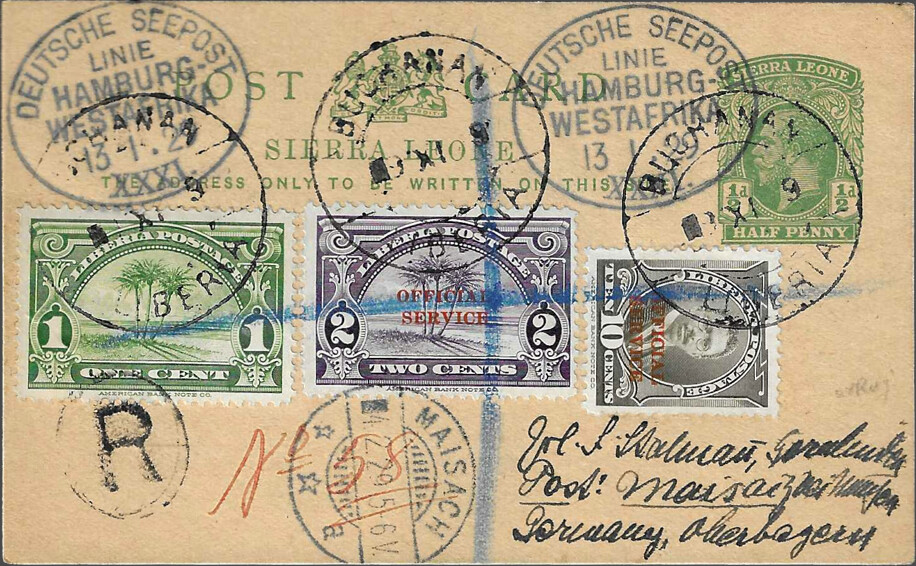
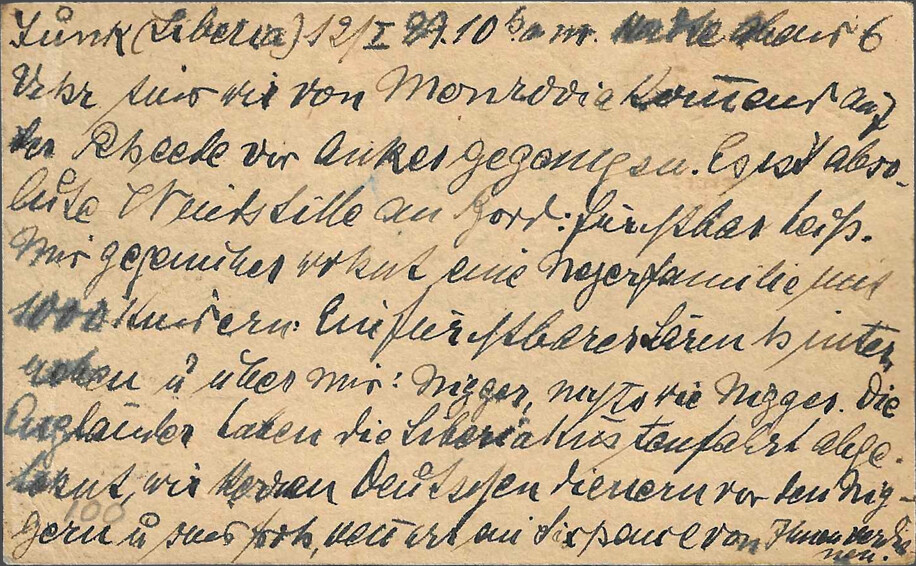
Transcript
Junk (Liberia) 12/I 29. 10 h a.m. [p.m.!] Heute abend 6
Uhr sind wir von Monrovia kommend auf
der Rheede vor Anker gegangen. Es ist abso-
lute Windstille an Bord: furchtbar heiß.
Mir gegenüber wohnt eine Negerfamilien mit
1000 Kindern. Ein furchtbarer Lärm hinter,
neben u. über mir: Nigger, nichts wie Nigger. Die
Engländer hatten die Liberiaküstenfahrt abge-
lehnt, wir Herren Deutschen dienern vor den Nig-
gern u. sind froh, wenn wir ein Sixpence von Ihnen verdie-
                                                          nen.
Translation
Junk (Liberia) 12 January 1929. 10 a.m. [sic: read p.m.]Coming from Monrovia, we anchored in the roadstead at 6 o’clock this evening. There is absolutely no wind on board: terribly hot. Across from me resides a Negro family with 1000 children. A terrible noise behind, next to, and above me: Niggers, nothing but niggers. The English had rejected the Liberian coast trip, we Germans bow to the niggers and are happy to earn a sixpence from them.
SEEPOST — 13 January 1929
Envelope franked with Liberian stamps postmarked SEEPOST 13 January 1929, cancelled and registered in Buchanan on 14 January, arrived in Maisach on 4 February.


Junk — 13 January 1929
Sierra Leone ½ penny postal card postmarked SEEPOST 13 January 1929, with additional Liberian stamps (13 cents) cancelled and registered in Buchanan on 14 January, arrived in Maisach on 4 February.
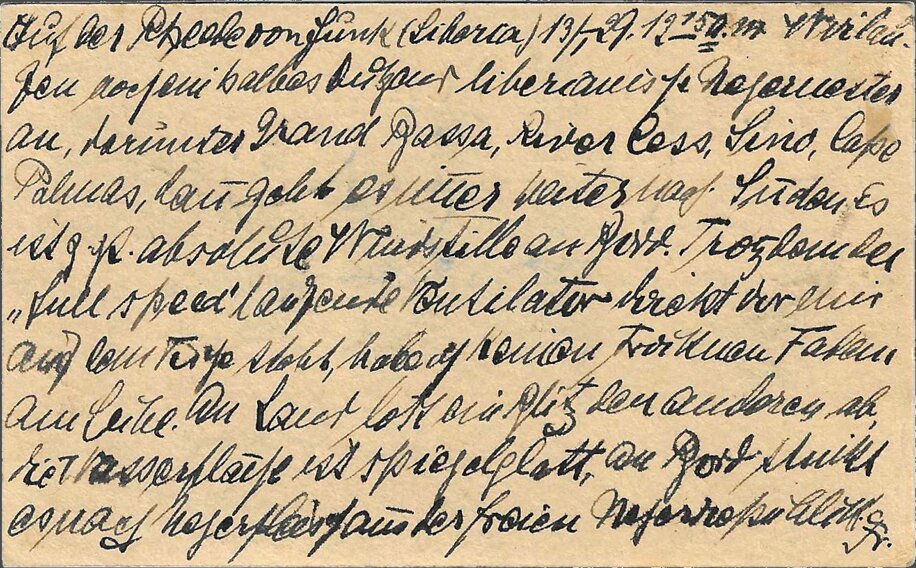
Transcript
Auf der Rheede von Junk (Liberia) 13/I-29, 12:15 a.m. Wir lau-
fen noch ein halbes Dutzend liberianische Negernester
an, darunter Grand Bassa, River Cess, Sino, Cape
Palmas, dann geht es immer weiter nach Süden. Es
ist z. Zt. absolute Windstille an Bord. Trotzdem der
„full speed“ laufende Ventilator direkt vor mir
auf dem Tische steht, habe ich keinen trocknen Faden
am Leibe. An Land löst ein Blitz den anderen ab,
die Wasserfläche ist spiegelglatt, an Bord stinkt
es nach Negerfleisch aus der freien Negerrepublik. Fr.
Translation
In the roadstead of Junk (Liberia) 13 January 1929, 12:15 a.m.We will call at half a dozen more Liberian Negro hamlets, including Grand Bassa, River Cess, Sino, and Cape Palmas, then continue south. Currently it is totally windless on board. Even though the fan is running at full speed right in front of me on the table, I have no dry thread on my body. On land, one flash of lightning follows another, the water is like a mirror, and on board it stinks of Negro meat from the Free Negro Republic. Fr.
Junk — 13 January 1929
Sierra Leone ½ penny postal card postmarked SEEPOST 13 January 1929, with additional Liberian stamps (13 cents) cancelled and registered in Buchanan on 14 January, arrived in Maisach on 4 February.

Transcript
Auf der Rheede von Junk (Liberia), den 13/I-29. 1 h a.m.
An Land ist ein sehr schweres Gewitter: Ununter-
brochenes Wetterleuchten (sheet lightening) von Don-
ner hören wir nichts. Das Gewitter war auch die Ursache
der unerträgliche[n] Schwüle. Jetzt setzt kühle Briese ein.
Man atmet erleichtert auf. Leider ist die Briese mehr
an Steuerbord, ich hoffe aber, daß sie nach u. nach nach Back-
bord, wo meine Kammer liegt, herum geht. Unsere zahlrei-
chen Negerpass[ag]iere (1. !!) Klasse u. Deckspassagiere
sind fast alle besoffen. Ich habe nun fast 4 Tage nur
ganz wenig Schlaf gehabt infolge der feuchten Hitze! Wenn
ich nicht bald Schlaf bekomme, brech ich zusammen. Ich habe un-
                                                      geheuren Durst. Fr.
Translation
In the roadstead of Junk (Liberia), 13 January 1929. 1 a.m.There’s a very heavy thunderstorm on land: continuous sheet lightening, we don’t hear any thunder. The storm was also the cause of the unbearable mugginess. Now a cool breeze sets in. You breathe a sigh of relief. Unfortunately, the breeze is more to starboard, but I hope that it gradually comes around to port, where my cabin is. Our numerous (1st class!!) Negro passers [-passengers!] and deck passengers are almost all sloshed. I’ve had very little sleep for almost 4 days now due to the humid heat! If I don’t get sleep soon, I’ll collapse. I am terribly thirsty. Fr.
Junk — 13 January 1929
Sierra Leone ½ penny postal card postmarked SEEPOST 13 January 1929, with additional Liberian stamps (15 cents) cancelled and registered in Buchanan on 14 January, arrived in Maisach in February.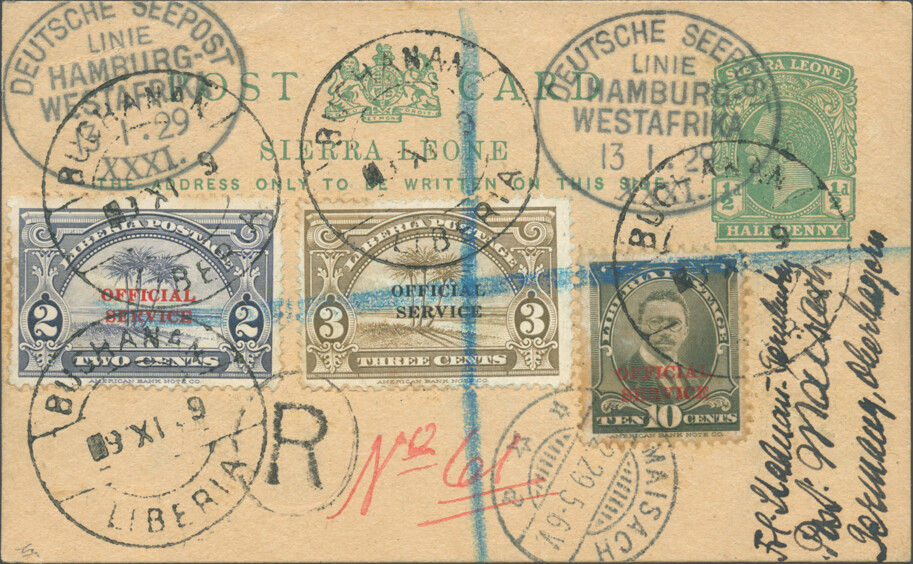
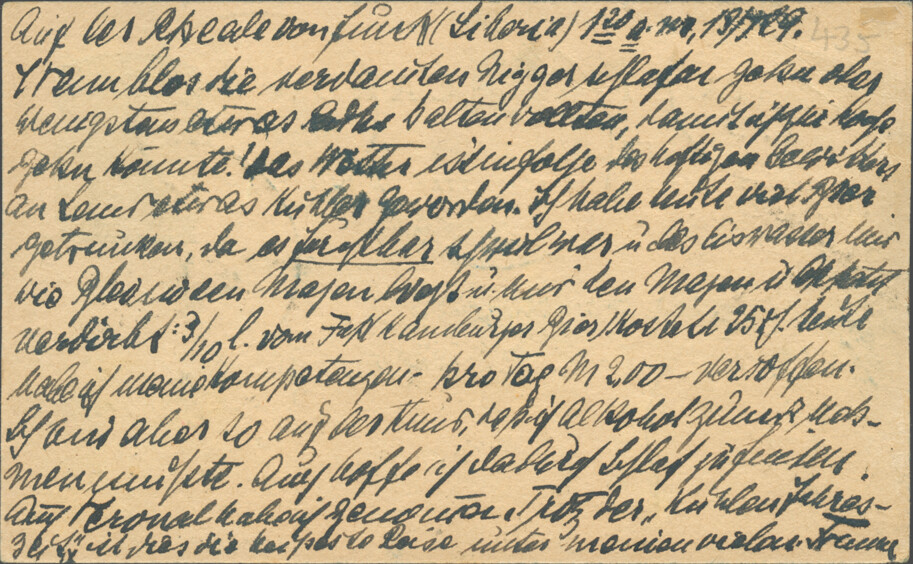
Transcript
Auf der Rheede von Junk (Liberia), 1:20 a.m., 13/I-29.
Wenn blos die verdammten Nigger schlafen gehen oder
wenigstens etwas Ruhe halten wollten, damit ich zur Koje
gehen könnte! Das Wetter ist infolge des heftigen Gewitters
an Land etwas kühler geworden. Ich habe heute viel Bier
getrunken, da es furchtbar schwül war und das Eiswasser mir
wie Blei in dem Magen liegt und mir den Magen und Appetit
verdirbt: 3/10 l. vom Fass Hamburger Bier kostete 25 pf. Heute
habe ich meine Kompetenzen - pro Tag M 200 - versoffen.
Ich bin aber so aus der […?], das ich Alkohol zu mir neh-
men musste. Auch hoffe ich dadurch Schlaf zu finden.
Auch Veronal habe ich genommen. Trotz der „kühlen Jahres-
zeit“ ist dies die heißeste Reise unter meinen vielen. Franke
Translation
In the roadstead of Junk (Liberia), 1:20 am, 13 January 1929.If only the damned niggers would go to sleep, or at least keep quiet so I could go to my bunk! The weather has gotten a bit cooler due to the violent thunderstorm on land. I drank a lot of beer today because it was terribly humid, and the ice water sits like lead in my stomach, ruining my stomach and my appetite: 3/10 liter of Hamburg draught beer cost 25 pf. Today I drank my allowance – M 200 per day. But I’m so out of […?] I had to drink alcohol. I also hope that will help me sleep. I’ve also taken Veronal. Despite the “cool season” this is the hottest of my many voyages.
Grand Bassa — 13 January 1929
Sierra Leone ½ penny postal card postmarked SEEPOST 13 January 1929, with additional Liberian stamps (5 cents) cancelled and registered in Rivercess on 28 January, Monrovia transit postmark dated 30 January, arrived in Maisach on 25 February.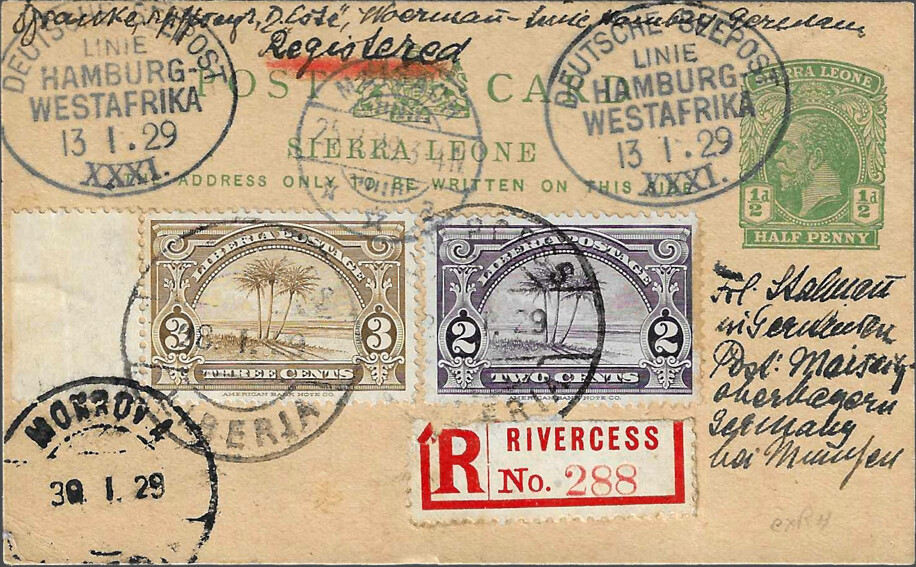

Transcript
Gran Bassa, den 13/I-29. 3:30 p.m. Nachdem wir bereits folgend-
de liberianische Häfen angelaufen haben: Cape Mount
(Robertsport) Monrovia u. Marschall Junk, stehen uns
noch folgende Niggernester bevor: River Cess, Sinoe, Nana
Kroo, Sasstown, Grand Cess, Cape Palmas, alles Liberia, dann kommt
Taboa [=Tabou], Sassandra, Grand Lahou, Gran Bassam, Assi-
nie u. Sekondi, also bis zur engl. Goldküste, dann geht es den-
selben Weg über Mano, Sulima, Freetown, Conakry, Dakar, Bat-
hurst, Bissao, Las Palmas, Teneriffe zurück nach Hamburg.
Am 27/II- sollen wir in Hamburg sein u. am 10/III- wieder fahren,
wir haben aber bereits 5 Tage Verspätung. So ungern ich es
tu, muß ich doch eine 2. Reise mitmachen. Gott sei Dank, daß
wir soeben den größten Teil unserer Niggerpassagiere losgeworden
                                                             sind! Fr
Translation
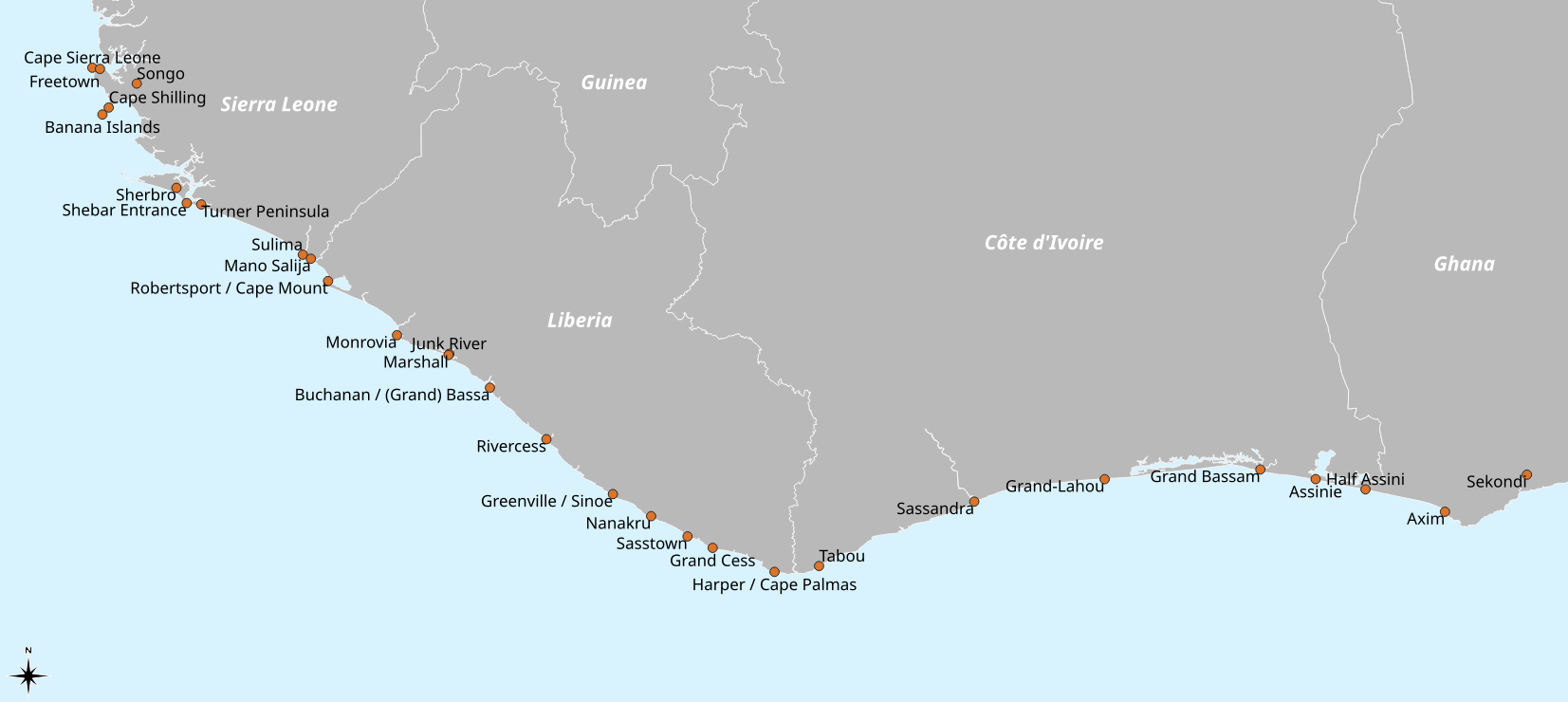
Grand Bassa, 13 January 1929, 3:30 p.m.After having already called at the following Liberian ports: Cape Mount (Robertsport), Monrovia, and Marshall Junk, we still have the following nigger hamlets ahead of us: River Cess, Sinoe, Nanakru, Sasstown, Grand Cess, Cape Palmas, all in Liberia, then Tabou, Sassandra, Grand Lahou, Grand Bassam, Assinie, and Sekondi, thus as far as the English Gold Coast. Then it will be the same route via Mano, Sulima, Freetown, Conakry, Dakar, Bathurst, Bissau, Las Palmas, and Tenerife back to Hamburg. We are supposed to be in Hamburg on the 27th of February and leave again on the 10th of March, but we are already five days late. As loathe as I am, I have to make a second voyage. Thank God that we just got rid of most of our nigger passengers! Fr
Buchanan — 14 January 1929
Picture postcard franked with a Liberian stamp (15 cents) cancelled and registered 15 January in Greenville, with Monrovia transit postmark dated 21 January, arrived in Maisach on 14 February.

Transcript
Buchanan (Grand Bassa) den 14/I-29. 5 h p.m.
Von „Marschall Junk“ sind wir heute hier
angekommen (6 h a.m.). Jetzt gehen wir
nach Sinoe weiter. Ich habe den
Kpt. u. Arzt der „Ivo“ - Hamburg-
Bremer-Afrika Linie - besucht. Sie ist
neu (1924) u. viel besser als die
26 jährige „Este“. Die Negerpassa-
giere bringen ihr ganzes Hab und
Gut (Ziegen, Schweine etc.) mit an
Bord. In Liberia möchte ich nicht
leben. Jeden Augenblick kommt so ein verdammter Niggerbeamter
in meine Kammer u. will gratis „sexal medicine“ haben. „I pay
you, when you come back!!?!“ Ich schmeiße die Gauner stets
raus. Ganz Liberia besteht nur aus Lumpen. Es ist dauernd heiß.
Translation
Buchanan (Grand Bassa) the 14th/I-29th. 5 p.m.We arrived here today (6 a.m.) from “Marshall Junk.” Now we are continuing to Sinoe. I visited the captain and doctor of the “Ivo” (HBAL). She is new (1924) and much better than the 26-year-old “Este.” The Negro passengers bring all their belongings (goats, pigs, etc.) on board. I wouldn’t want to live in Liberia. At any moment, some damned nigger official comes into my room and wants free “sexal medicine.” “I’ll pay you when you come back!!?!” I always throw the crooks out. All of Liberia is made up of scoundrels. It is constantly hot.
Nanakru — 15 January 1929
Picture postcard postmarked SEEPOST 15 January 1929, franked with Liberian stamps (13 cents) cancelled and registered 15 February in Nanna Kroo, with Monrovia transit postmark dated 30 January.

Transcript
Auf der Fahrt von Sinoe (Greenville) den 15/I-29. 2 h p.m.
nach Nanakroo (Liberia). In Greenville
war ich an Land. Die Einfahrt ist sehr
schön. Nur eine einzige Straße ist im
Dorf vorhanden, die einigermaßen
passierbar ist, sonst nichts wie Sand
in den man bis zum Knöchel ein-
sinkt wie in Swakopmund. Die
Häuser bestehen nur aus verroste-
tem Wellblech. Die Post ist eine bald
zerfallene Bude. Nur 9 Weiße le-
ben da, welche zur Firma West u.
Co in Hamburg gehören. Die Schwarzen sind von der Kultur her
weniger verdorben, daher höflicher als in den bisher besuchten
Teilen Liberias. Die dürren Schweine laufen in den Straßen
herum u. lesen das auf, was die Schwarzen von sich geben!!!
Translation
On the journey from Sinoe (Greenville) on January 15, 1929, at 2 p.m. to Nanakroo (Liberia).I went ashore in Greenville. The [port] entrance is very beautiful. There is only one road in the village that is reasonably traversable, otherwise, nothing but sand, into which you sink up to your ankles, like in Swakopmund. The houses consist only of rusted corrugated metal. The post office is a soon collapsing shack. Only nine white people live there, who belong to the West & Co. company in Hamburg. The Blacks are less culturally corrupted, and therefore more polite than in the parts of Liberia I have visited so far. The skinny pigs wander around the streets, picking up what the Blacks drop!!!
Nanakru — 15 January 1929
Picture postcard postmarked SEEPOST 15 January 1929, franked with Liberian stamps (13 cents) cancelled and registered 15 February in Nanna Kroo, with Monrovia transit postmark dated 30 January.

Transcript
Auf der Fahrt von Sinoe (Greenville) nach Nanakroo, 15/I-29. 2:30 p.m.
In Sinoe wie in Buchanan (Grand
Bassa) habe ich auch wieder wie 1922 in
in Santa Isabel (Fernando Poo) die
in Massen in den Palmen nisten-
den Webervögel gesehen, welche lan-
ge Streifen aus den Palmenblättern
reißen, womit sie ihre frei hän-
genden Nester bauen, sie ver-
führen [ver-üben/voll-führen?] einen maßlosen Ŕadau.
Jetzt laß ich mich auch von den Post-
onkeln nicht mehr betrügen, da ich endlich genau über den Kurs
unterrichtet bin. In Robertsport u. Monrovia haben mich die
Postbeamten noch mächtig betrogen. In Sinoe habe ich die Mar-
ken von West u. Co. gekauft, dann kam der Postonkel selbst an Bord
u. wollte Marken an mich verkaufen, wir wurden aber nicht handelseinig.
Translation
On the journey from Sinoe (Greenville) to Nanakroo, 15 January 1929, 2:30 p.m.In Sinoe and in Buchanan (Grand Bassa), I again saw, as in Santa Isabel (Fernando Poo) in 1922, masses of weaverbirds nesting in the palm trees, which tear long strips from the palm leaves with which they build their free-hanging nests, they make a huge noise. Now I won’t let the post guys cheat me anymore, since I am finally well informed about the [exchange] rate. In Robertsport and Monrovia, the post office clerks cheated me badly. In Sinoe, I bought the stamps from West and Co., then the post guy himself came on board and wanted to sell me stamps, but we couldn’t reach an agreement.
Nanakru — 15 January 1929
Picture postcard postmarked SEEPOST 15 January 1929, franked with Liberian stamps (13 cents) cancelled and registered 15 February in Nanna Kroo, with Monrovia transit postmark dated 30 January.
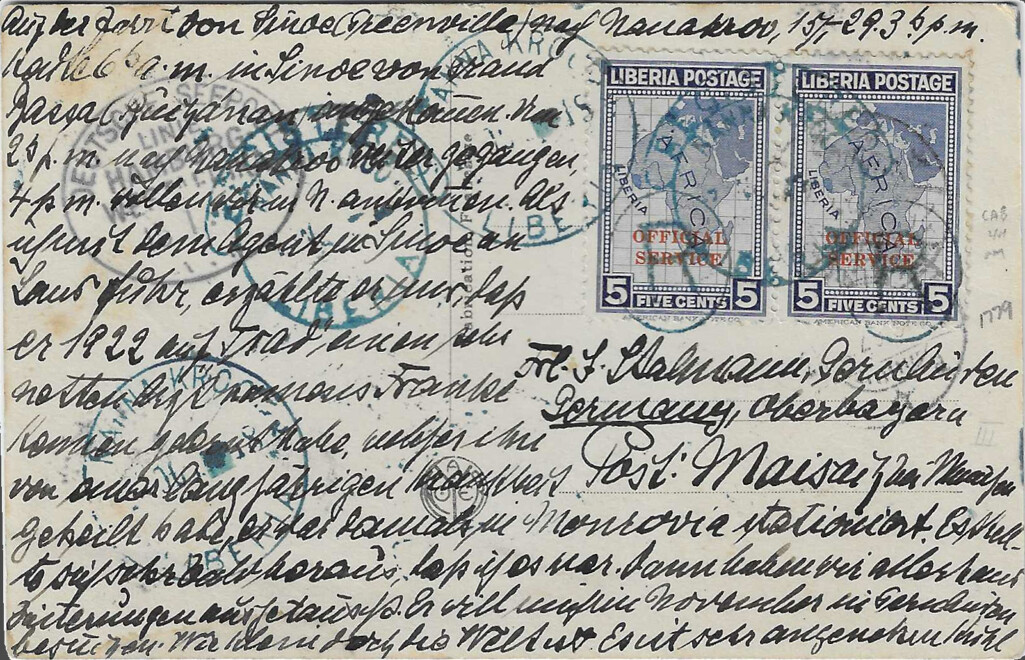
Transcript
Auf der Fahrt von Sinoe (Greenville) nach Nanakroo, 15/I-29. 3 h p.m.
Heute 6 h a.m. in Sinoe von Grand Bassa (Buchanan) angekommen. Um
2 h p.m. nach Nanakroo weiter gegangen,
4 p.m. wollen wir in N. ankommen. Als
ich mit dem Agent in Sinoe an
Land fuhr, erzählte er mir, daß
er 1922 auf „Tsad“ einen sehr
netten Arzt namens Franke
kennen gelernt habe, welcher ihn
von einer langjährigen Krankheit
geheilt habe, er war damals in Monrovia stationiert. Es stell-
te sich sehr bald heraus, daß ich es war. Dann haben wir allerhand
Erinnerungen ausgetauscht. Er will mich im November in Gernlinden
besuchen. Wie klein doch die Welt ist. Es ist sehr angenehm kühl.
Translation
On the journey from Sinoe (Greenville) to Nanakroo, 15 January 1929. 3 p.m.Arrived today at 6 a.m. in Sinoe from Grand Bassa (Buchanan). Continued to Nanakroo at 2 p.m., we intend to arrive in N. at 4 p.m. When I went ashore with the agent in Sinoe, he told me that in 1922, on the “Tsad,” he had met a very nice doctor named Franke, who had cured him of a longtime illness. He was stationed in Monrovia back then. It very soon became clear that it was me. We then exchanged all kinds of memories. He wants to visit me in Gernlinden in November. What a small world it is. It is very pleasantly cool.
Nanakru — 15 January 1929
Picture postcard postmarked SEEPOST 16 January 1929, franked 15 cents, cancelled and registered in Rivercess on 7 Februar, arrived in Maisach on 8 March.

Transcript
Nanna Kroo (Liberia), den 15/I-29. 11 h p.m.
4:30 p.m. hier angekommen von Sinoe,
sofort mit Landungsboot an Land
gefahren. Fahrtdauer 3/4 Stunde. Kein
Weißer wohnt hier. In der Nähe liegt ei-
ne Wesleyan-Mission. Keine Straßen.
Die Eingeborenen noch unverdorben
und große Kinder. Der schwarze Zoll-
einnehmer ist auch Postmaster. Zur
Aufgabe meiner 4 Postkarten
habe ich mit dem Postonkel zusam-
men erst den Poststempel gesucht. Schließ-
lich fanden wir in einem alten Schranke einen alten verrosteten
Stempel, in welchem keine Typen mehr auszuwechseln waren. 9 h p.m.
bin ich in stockfinsterer Nacht nach der „Este“, welche Sonnenbrenner an
den Masten aufgezogen hatte, zurückgefahren; noch immer großer Radau an Bord.
„Sonnenbrenner“ waren Petroleumlampen der Firma R. Ditmar, Wien,
Österreichs größtem Lampenhersteller. Deren Brenner waren mit zwei Dochten
ausgestattet: einem speziellen, grobmaschigen, weichen Saugdocht, der eine
möglichst große Menge Öl nach oben transportierte und über eine relativ
große Kontaktfläche an den eigentlichen Brenndocht abgab.
Bildseite:
Sasstown, 16.I.1929. 7 h a.m.
6 h a.m. in Sasstown ange-
kommen; ich fahre nicht an
Land, weil zu abgespannt
bin, u. wir nur 3-4 Stunden
hier bleiben. Es ist kühl.
         Sasstown ist
         ein kleines
         Nest wie alle.
Translation
Nanakru (Liberia), 15 January 1929. 11 p.m.Arrived here from Sinoe at 4:30 p.m., immediately went ashore by landing craft. Journey time 45 minutes. No white people live here. There is a Wesleyan mission nearby. No roads. The natives are still unspoiled and big children. The black customs officer is also the postmaster. To mail my 4 postcards, post guy and I first searched for the handstamp. In the end, in an old locker, we found an old, rusty handstamp, whose types were no longer interchangeable. At 9 p.m., in the pitch-black night, I returned to the “Este,” which had hoisted “Sonnenbrenner” on the masts; still much noise on board.
The German term “Sonnenbrenner” meaning “sun burner(s)” refers to oil lamps made by the R. Ditmar company, Vienna, Austria’s largest lamp manufacturer. Their burners were equipped with two wicks: a special, coarse-mesh, soft suction wick which transported the largest possible amount of oil upwards and released it to the actual burning wick over a relatively large contact surface.
picture side:
Sasstown, 16 January 1929. 7 a.m.
Arrived in Sasstown at 6 a.m.; I am not going ashore because I am too exhausted, and we shall only be here for 3-4 hours. It’s nippy. Sasstown is a hamlet like any other.
SEEPOST — 16 January 1929
Official “Nanna Kroo Post Office” envelope franked with Liberian stamps (20 cents) postmarked SEEPOST 16 January 1929, cancelled and registered 18 January in Harper, arrived in Maisach on 6 February.

Sasstown → Grand Cess — 16 January 1929
Picture postcard postmarked SEEPOST 16 January 1929, franked 16 cents cancelled and registered in Harper on 18 January, arrived in Maisach in February (likely the 6th).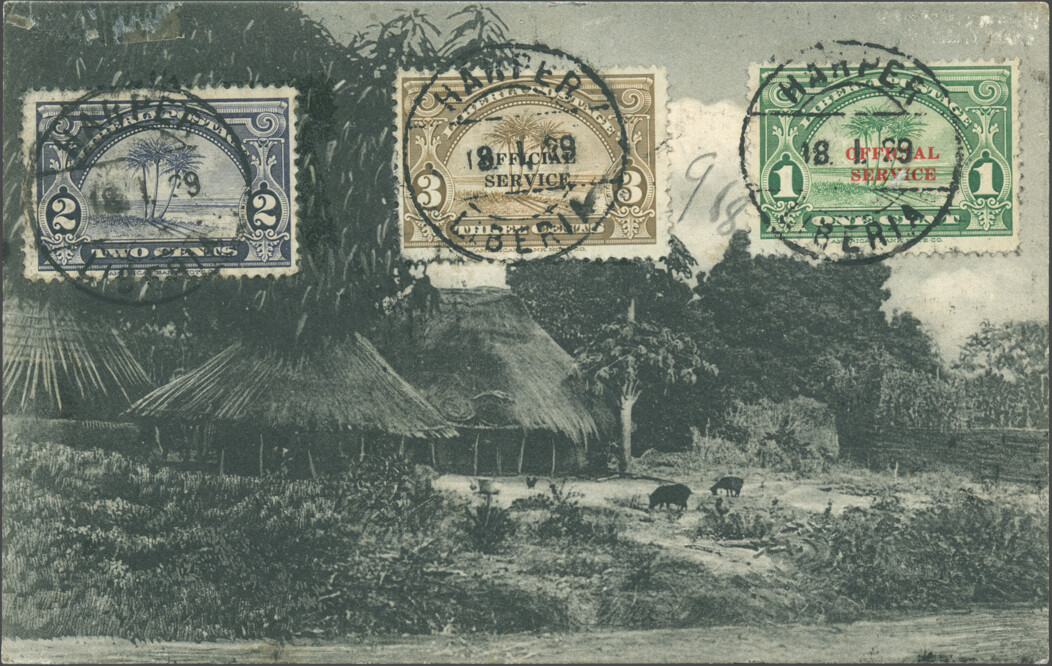
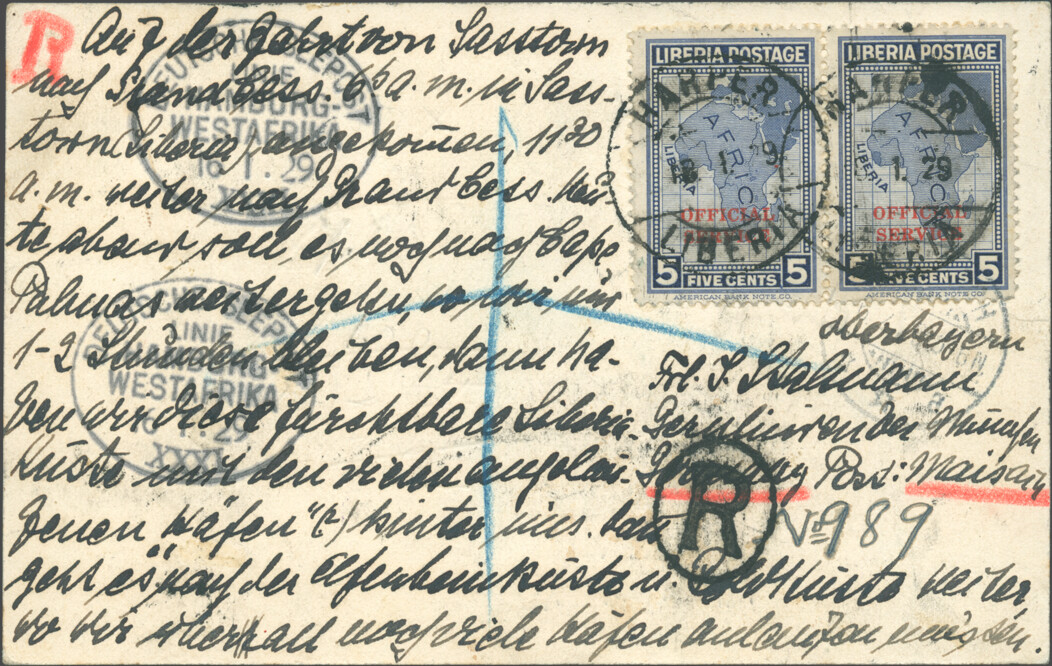
Transcript
    Auf der Fahrt von Sasstown
nach Grand Cess. 6 h a.m. in Sass-
town (Liberia) angekommen, 11:30
a.m. weiter nach Grand Cess. Heu-
te abend soll es noch nach Cape
Palmas weitergehen, wo wir nur
1-2 Stunden bleiben, dann ha-
ben wir diese furchtbare Liberia-
Küste mit den vielen angelau-
fenen „Häfen“ (?) hinter uns. Dann
geht es nach der Elfenbeinküste u. Goldküste weiter,
wo wir überall noch viele Häfen anlaufen müssen.
Translation
En route from Sasstown to Grand Cess.6 a.m. arrived in Sasstown (Liberia), 11:30 a.m. onward to Grand Cess. This evening we’re supposed to continue to Cape Palmas, where we’ll only stay for 1-2 hours, then we’ll have this terrible Liberian coast with the many “ports” (?) behind us. Then we continue to the Ivory Coast and Gold Coast, where we still must call at many ports.
Grand Cess — 16 January 1929
German 8 pfennigs postal card postmarked SEEPOST 16 January 1929, with additional German 10 pfennigs airmail stamp and Liberian stamps (24 cents) cancelled and registered in Harper on 18 January, arrived in Maisach on 6 February.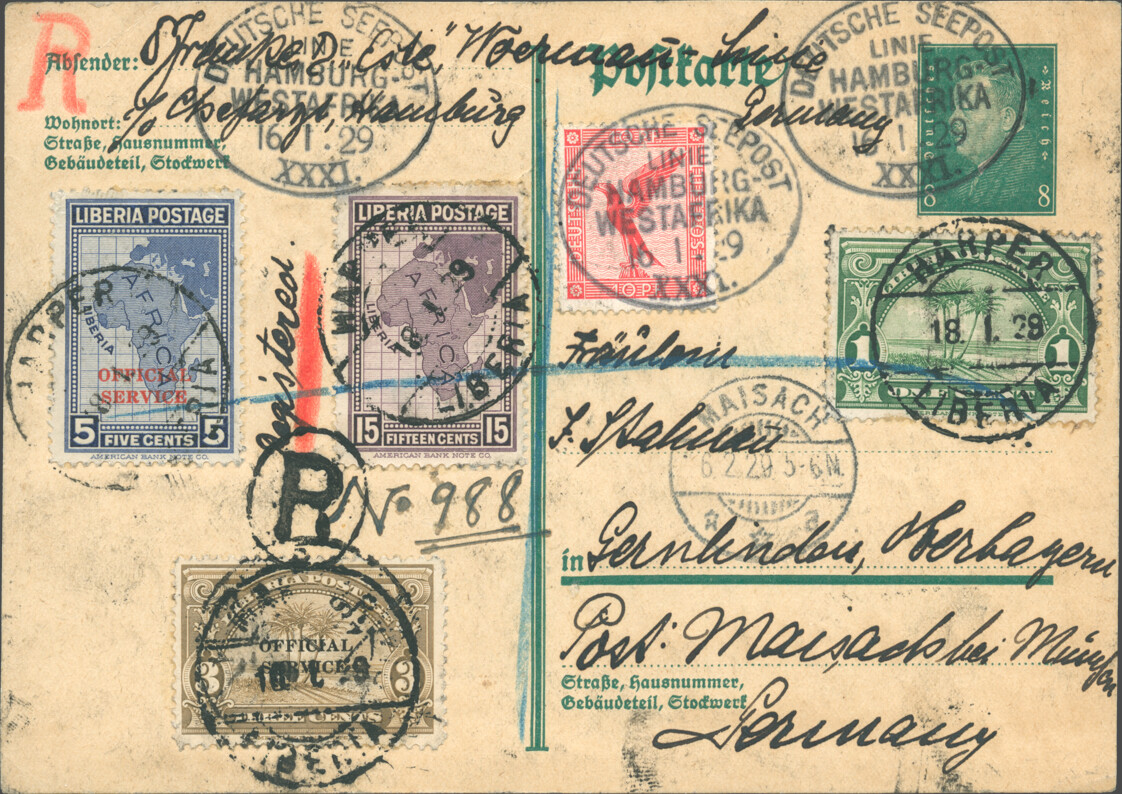

Transcript
Grand Cess (Liberia) 2 h p.m., den 16/I-29. Heute
abend gehen wir nach dem letzten liberianischen
Hafen weiter. Die Liberia-Fahrt ist interessant
aber sehr angreifend. Fast jeden Tag haben wir
zwei Plätze angelaufen, an einem Tag so-
gar drei, Ladung gelöscht u. Ladung genommen.
Ich bin fast an jedem Platz an Land gewe-
sen, was mit Lebensgefahr verbunden ist, da
man durch die Brandung durch muß. Zu
der Regenzeit ist die Brandung oft tagelang
nicht passierbar, dann muß das Schiff manch-
mal mehrere Tage auf Rheede vor Anker liegen. Fr.
Translation
Grand Cess (Liberia) 2 p.m., 16 January 1929.This evening, we’ll proceed to the last Liberian port. The Liberia trip is interesting but very exhausting. Almost every day we called at two places, one day even three, discharged cargo and loaded cargo. I have been on land at almost every place, which is dangerous because you have to go through the surf. During the rainy season the surf is often impassable for days, and the ship sometimes has to lie anchored offshore for several days. Fr.
Grand Lahou, SEEPOST — 19 January 1929
Envelope franked with French Ivorian stamps (3 francs 45 centimes) postmarked SEEPOST 19 January 1929, cancelled and registered in Grand Bassam on 27 January, arrived in Maisach on 7 February.

Sekondi → Grand Bassam — 28 January 1929
Picture postcard franked with French Ivorian stamps (1 franc 65 centimes) cancelled and registered 29 January 1929 in Grand Bassam, arrived in Maisach on 23 February.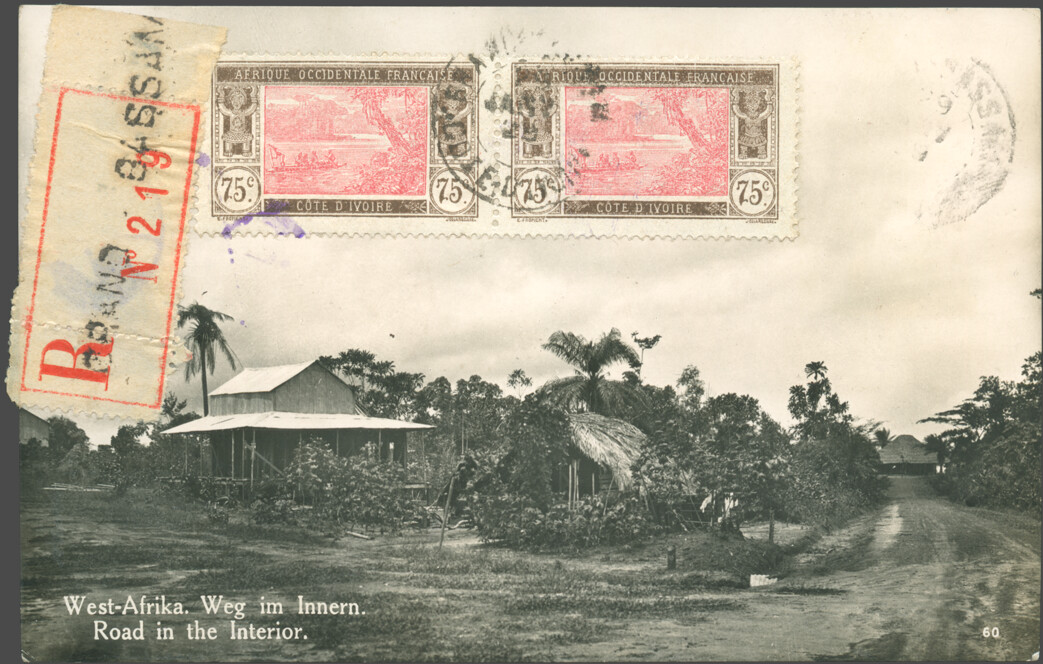
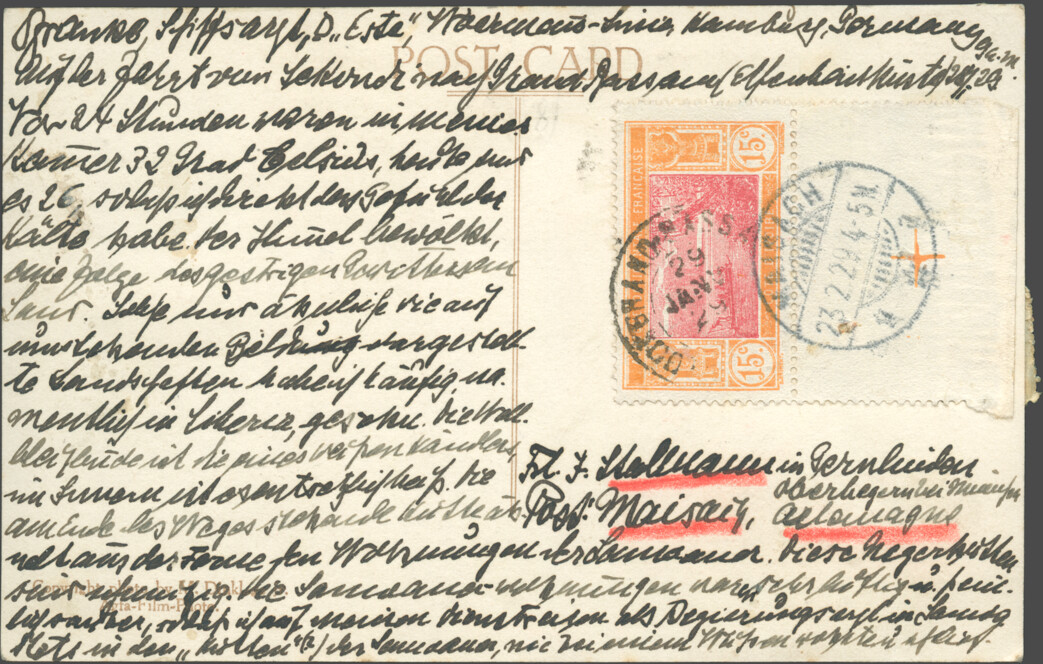
Transcript
Franke, Schiffsarzt D„Este“, Woermann-Linie, Hamburg, Germany.  9 a.m.
Auf der Fahrt von Sekondi nach Grand Bassam (Elfenbeinküste) 28/I-29.
Vor 24 Stunden waren in meiner
Kammer 32 Grad Celsius, heute sind
es 26, sodass ich direkt das Gefühl der
Kälte habe. Der Himmel bewölkt,
eine Folge des gestrigen Gewitters an
Land. Solche und ähnliche wie auf
umstehendem Bild dargestell-
te Landschaften habe ich häufig na-
mentlich in Liberia gesehen. Die Well-
blechbude ist die eines weißen Händlers,
im Innern ist es entsetzlich heiß. Die
am Ende des Weges stehende Hütte äh-
nelt aus der Ferne den Wohnungen der Samoaner. Diese Negerhütten
sind schmutzig. Die Samoaner-Wohnungen waren sehr luftig u. pein-
lich sauber, sodass ich auf meinen Dienstreisen als Regierungsarzt in Samoa
stets in den „Hütten“ (?) der Samoaner, nie bei einem Weißen wohnte u. schlief.
Translation
Franke, ship’s doctor SS “Este,” Woermann Line, Hamburg, Germany.En route from Sekondi to Grand Bassam (Ivory Coast) 28 January 1929. 9 a.m.
24 hours ago it was 32 degrees Celsius in my room, today it’s 26, so I immediately have the feeling of cold. The sky is cloudy, a result of yesterday’s thunderstorm on land. I have often seen such landscapes and similar to those shown in the picture overleaf, especially in Liberia. The corrugated iron stall is that of a white tradesman, and it is terribly hot inside. From a distance, the hut at the end of the path resembles the homes of the Samoans. These Negro huts are dirty. The Samoan dwellings were very airy and scrupulously clean, so that on my business trips as a government doctor in Samoa I always lived and slept in the “huts” (?) of the Samoans, never with a white person.
Axim → Half-Assini — 28 January 1929
Picture postcard franked with French Ivorian stamps (2 francs 50 centimes) cancelled and registered 29 January 1929 in Grand Bassam, arrived in Maisach on 23 February.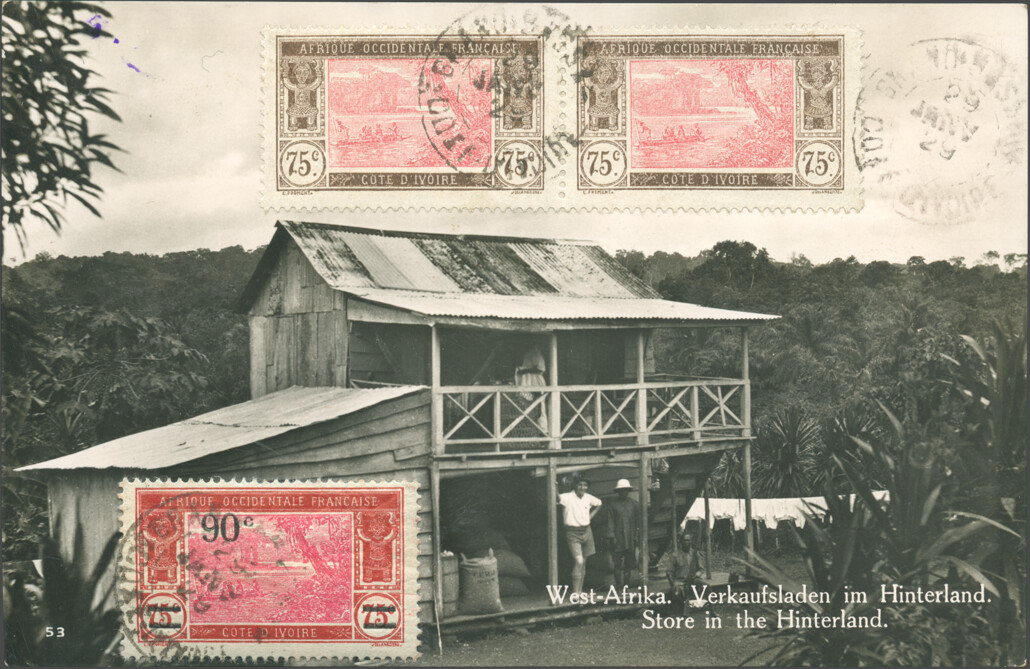
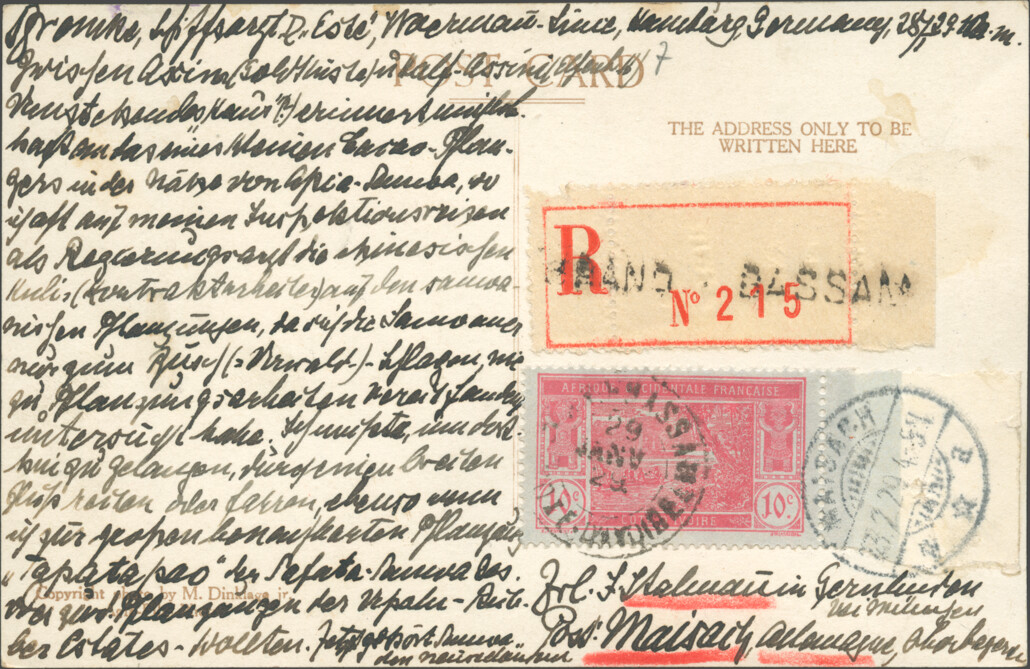
Transcript
Franke, Schiffsarzt D„Este“, Woermann-Linie, Hamburg, Germany, 28/I-29. 11 a.m.
Zwischen Axim (Goldküste) u. Half-Assini (Elfenb.k.) [sic!]
Umstehendes „Haus“ (?) erinnert mich leb-
haft an das eines kleinen Cacao-Pflan-
zers in der Nähe von Apia-Samoa, wo
ich oft auf meinen Inspektionsreisen
als Regierungsarzt die chinesischen
Kulis (Kontraktarbeiter) auf den samoa-
nischen Pflanzungen, da sich die Samoaner
nur zum Busch(=Urwald)-Schlagen, nie
zu Pflanzungsarbeiten bereit fanden,
untersucht habe. Ich mußte, um dort-
hin zu gelangen, durch einen breiten
Fluß reiten oder fahren, ebenso wenn
ich zur benachbarten großen Pflanzung
„Tapatapao“ der Safata-Samoa Ges.
oder zu d. Pflanzungen des Upolu-Rub-
ber Estates wollten. Jetzt gehört Samoa
den Neuseeländern.
Grund für sic:
Half-Assini liegt ebenfalls in der Goldküste nahe der Grenze zur Elfenbeinküste.
Translation
Franke, ship’s doctor SS “Este,” Woermann Line, Hamburg, Germany, 28 January 1929. 11 a.m.Between Axim (Gold Coast) and Half-Assini (Ivory Coast) [sic: read Gold Coast]
The “house” (?) overleaf reminds me vividly of that of a small cacao planter near Apia Samoa, where I often examined the Chinese coolies (contract workers) on the Samoan plantations during my inspection trips as a government doctor, since the Samoans were only ever willing to cut down the bush (=jungle), never to do planting work. To get there I had to ride or drive through a wide river, also if I wanted to go to the neighboring large plantation “Tapatapao” of the Safata Samoa Co. or to the plantations of the Upolu Rubber Estate. Now Samoa belongs to the New Zealanders.
Grand Bassam — 28 January 1929
Picture postcard franked with French Ivorian stamps (2 francs 40 centimes) cancelled and registered 29 January 1929 in Grand Bassam, arrived in Maisach on 23 February.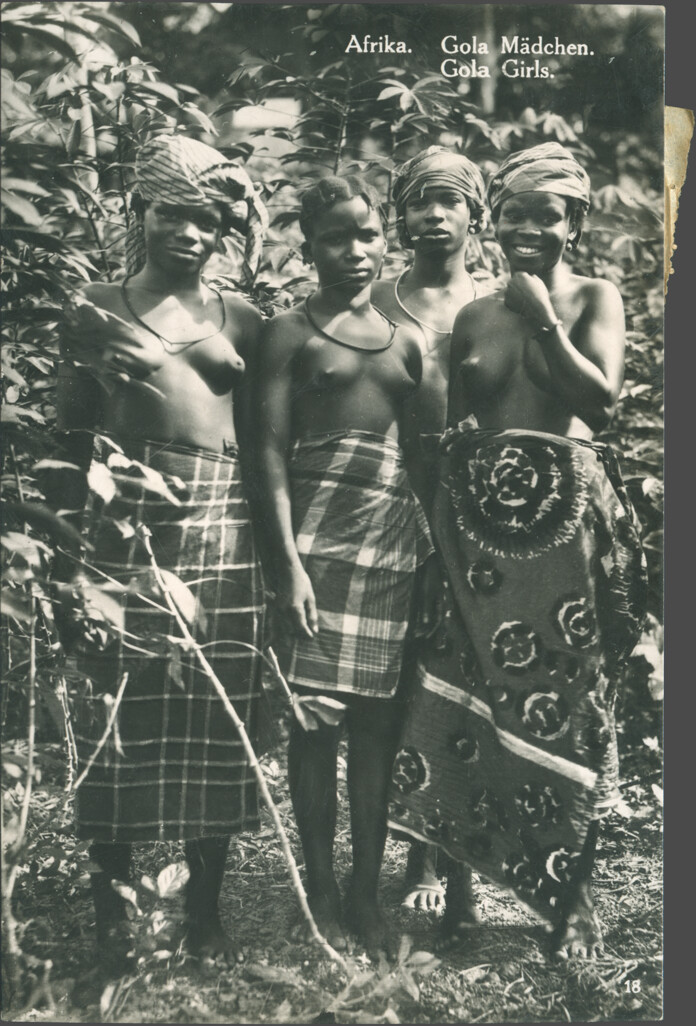
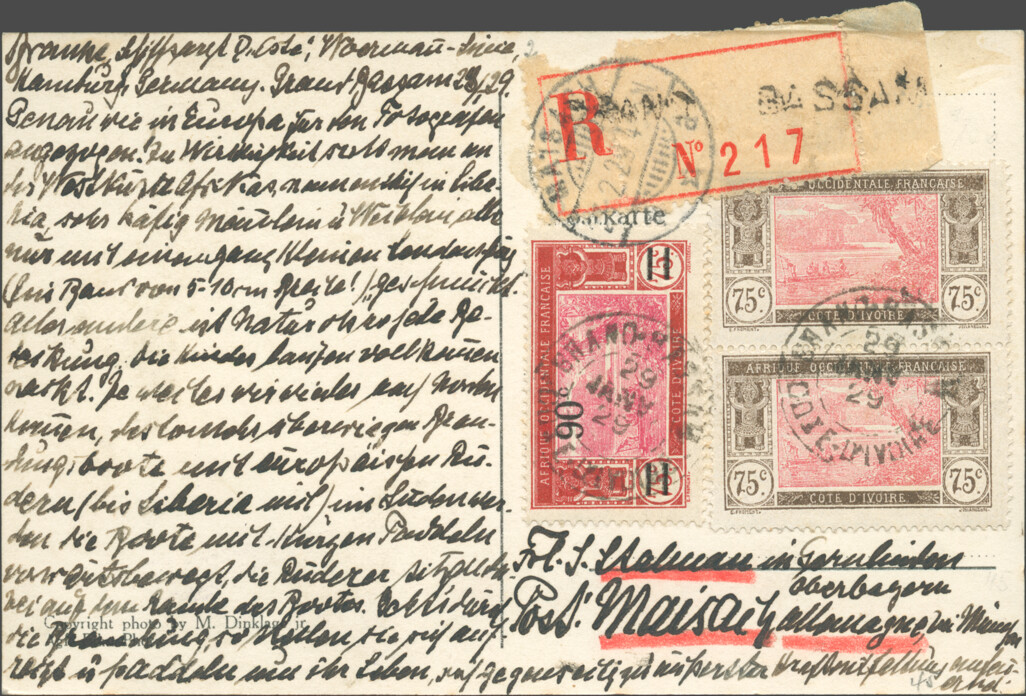
Transcript
Franke, Schiffsarzt D„Este“, Woermann-Linie,
Hamburg, Germany. Grand Bassam 28/I-29.
Genau wie in Europa für den Fotografen
angezogen! In Wirklichkeit sieht man an
der Westküste Afrikas, namentlich in Libe-
ria, sehr häufig Männlein und Weiblein alle
nur mit einem ganz kleinen Lendenschurz
(Ein Band von 5-10 cm Breite!) „geschmückt“.
Alles andere ist Natur ohne jede Be-
deckung, die Kinder laufen vollkommen
nackt. Je weiter wir wieder nach Norden
kommen, desto mehr überwiegen Bran-
dungsboote mit europäischen Ru-
dern (bis Liberia incl) im Süden wer-
den die Boote mit kurzen Paddeln
vorwärtsbewegt, die Ruderer sitzen da-
bei auf dem Rande des Bootes. Geht’s durch
die Brandung, so stellen sie sich auf-
recht u. paddeln um ihr Leben, sich gegenseitig zu äußerster Kraftentfaltung anfeu-
                                                                                        ernd.
Translation
Franke, ship’s doctor SS “Este,” Woermann Line, Hamburg, Germany. Grand Bassam 28 January 1929.Just like in Europe dressed for the photographer! In reality, on the west coast of Africa, especially in Liberia, you often see men and women “adorned” with only a very small loincloth (a belt 5-10 cm wide!). Everything else is nature without covering anything, the children run completely naked. The further north we go, the more the surfboats with European oars predominate (as far as Liberia). In the south, the boats are moved forward with short paddles, the rowers sitting on the edge of the boat. When going through the surf, they stand up and paddle for their lives, spurring each other to utmost exertion.
Sasstown — 5 February 1929
Picture postcard postmarked SEEPOST 6 February 1929, franked with a Liberian stamp (15 cents) cancelled and registered 7 February in Rivercess, arrived in Maisach on 8 March.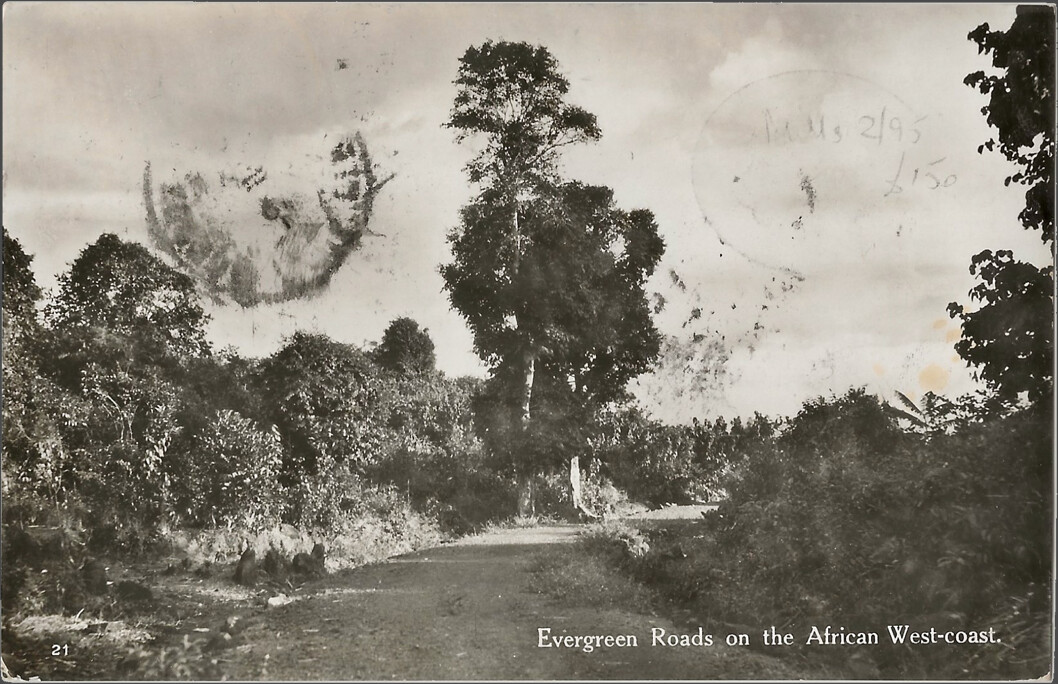

Transcript
Sasstown (Liberia), 5/II-29. 6 h p.m. Abs. Dr Franke, Schiffsarzt D„Este“, c/o Chefarzt der Woermann-
Von 2 p.m-3:30 p.m. war ich an Land. Das Schiff liegt weitab                           linie, Hamburg
von Land. Vor dem Strande liegen riesige Felsblöcke                                              Germany
welche der hohe Seegang unterwaschen hat. Zwischen
diesen Felsblöcken muß man mit dem Landungs-
boote hindurch. In der jetzigen Jahreszeit ist’s wenig gefähr-
lich, aber wenn hoher Seegang ist, ist hier für die Post
die gefährlichste Stelle, die ich an der Westküste kenne und
ich kenne von meinen zahlreichen Seereisen die Küste
ziemlich ausgiebig. Eine Postanstalt existiert in Sasstown
ebensowenig wie in Grand Cess. Wenigstens sagten es
an beiden Plätzen die verdammten Nigger-„Custom-
Officers“. Warscheinlich haben sie die Poststempel bei den
unbeschreiblich schlampigen Verhältinissen, die in der Neger
Republik Liberia herrschen, verloren. Es ist eine [Schimaere?]
daß Liberia „frei u. selbständig“ ist. Elendes Niggerpack!!
Translation
Sasstown (Liberia), 5 February 1929, 6 p.m. Sender Dr. Franke, ship’s doctor SS “Este,” c/o Chief Medical Officer of the Woermann Line, Hamburg, GermanyI was ashore from 2 p.m. to 3:30 p.m. The ship is lying far from land. Huge boulders lie off the beach, scoured by the high seas. The landing craft has to navigate between these boulders. At this time of year, it’s not very dangerous, but when the seas are rough, this is the most dangerous place for mail that I know on the west coast, and I know the coast quite well from my numerous sea voyages. There is no post office in Sasstown, just as there is no post office in Grand Cess. At least, that’s what the damned nigger “customs officers” said at both places. They probably lost the handstamps due to the indescribably sloppy conditions that prevail in the Negro Republic of Liberia. It’s a [chimaera?] that Liberia is “free and independent.” Damn nigger vermin!!
Sasstown — 5 February 1929
Picture postcard postmarked SEEPOST 6 February 1929, franked with Liberian stamps (13 cents) cancelled and registered 7 February in Rivercess, arrived in Maisach (likely on 8 March).

Transcript
Sasstown (Liberia) 5/II-29. 6:30 p.m.
Wenn Sasstown englisch wäre,
so möchte [?] hier wie in den anderen
von mir besuchten Plätzen Liberias
leben, aber [… … …?], solan-
ge Liberia eine freie, selbständige
Republik ist. Alle sind maßlos
frech u. stehlen alles Erreichbare.
[… … …?] = Text is zu stark durch Stempel verdeckt.
Translation
Sasstown (Liberia) 5 February 1929. 6:30 p.m.If Sasstown were English, [I] could live here, like in the other places of Liberia I visited, but [… … …?], as long as Liberia is a free, independent republic. They are all incredibly cheeky and steal everything within their reach.
[… … …?] = Text is too obscured by postmarks to read.
SEEPOST — 6 February 1929
Envelope franked with Liberian stamps postmarked SEEPOST 6 February 1929, cancelled and registered in Rivercess on 7 February, arrived in Maisach on 8 March.


Sinoe → Rivercess — 6 February 1929
Picture postcard postmarked SEEPOST 6 February 1929, franked with a Liberian stamp (15 cents) cancelled and registered 7 February in Rivercess, arrived in Maisach on 8 March.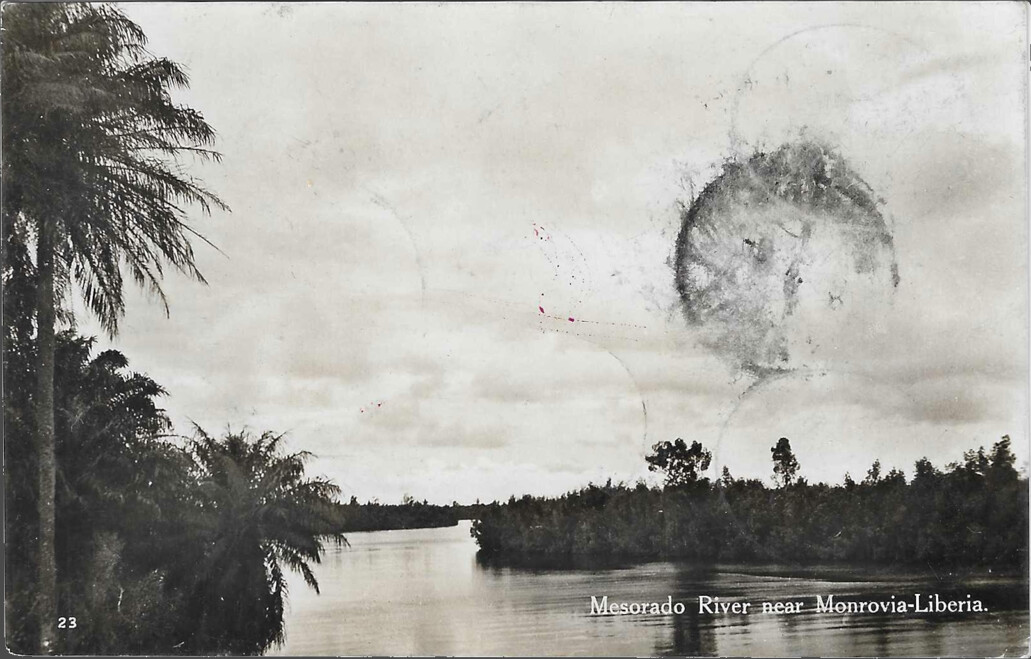
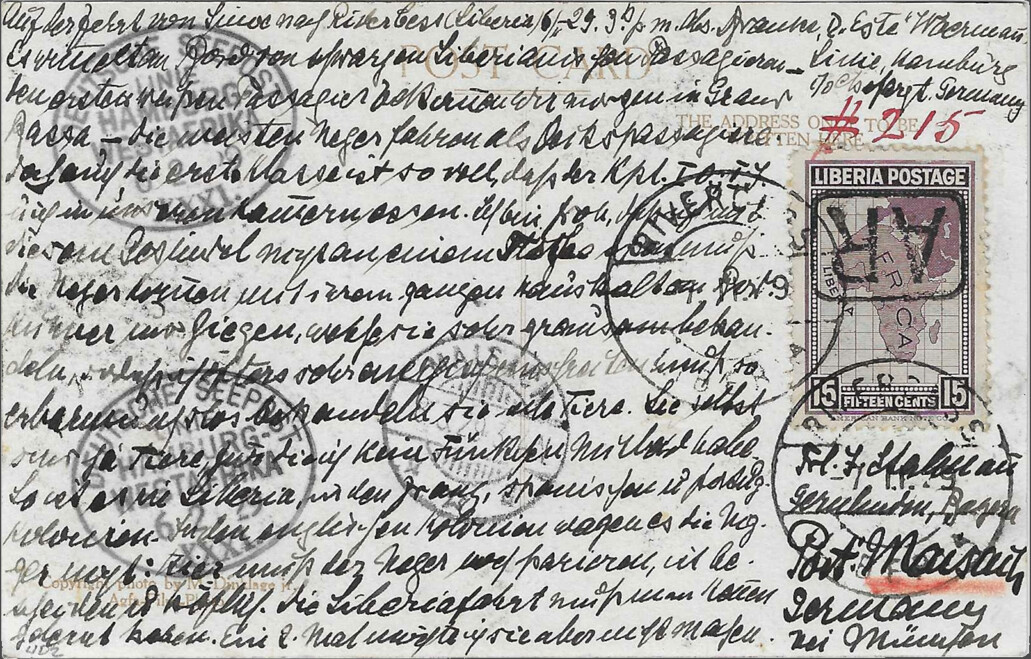
Transcript
Auf der Fahrt von Sinoe nach River Cess (Liberia) 6/II-29. 9 h p.m. Dr. Franke, D„Este“ Woermann-
Es wimmelt an Bord von schwarzen Liberianischen Passagieren -                      Linie, Hamburg
den ersten weißen Passagier bekommen wir morgen in Grand                  c/o Chefarzt, Germany
Bassa - die meisten Neger fahren als Deckspassagiere.
Doch auch die erste Klasse ist so voll, daß der Kpt., 1.O. [=1. Offizier], 1.I. [=Leitender Ingenieur]
u. ich in unseren Kammern essen. Ich bin froh, daß ich mit
diesem Gesindel nicht an einem Tische sein muß.
Die Neger kommen mit ihrem ganzen Haushalt an Bord,
Hühner und Ziegen, welche sie sehr grausam behan-
deln, sodaß ich öfters sehr energisch einschreiten muß, so
erbarmungslos behandeln sie die Tiere. Sie selbst
sind ja Tiere, für die ich kein Fünkchen Mitleid habe.
So ist es in Liberia, in den franz., spanischen u. portug.
Kolonien. In den englischen Kolonien wagen es die Nig-
ger nicht: Hier muß der Neger noch parieren, ist be-
scheiden u. höflich. Die Liberiafahrt muß man kennen
gelernt haben. Ein 2. mal möchte ich sie aber nicht machen.
Translation
On the journey from Sinoe to River Cess (Liberia) 6 February 1929. 9 p.m. Dr. Franke, SS “Este” Woermann Line, Hamburg, c/o Chief Medical Officer, GermanyThe ship is teeming with Black Liberian passengers – we will get our first white passenger tomorrow in Grand Bassa – most of the Blacks are deck passengers. But even the first class is so full that the captain, the first officer, the chief engineer, and I eat in our cabins. I am glad I don’t have to share a table with this mob. The Blacks come aboard with their entire household, chickens and goats, which they treat very cruelly, so that I often have to intervene very firmly, so mercilessly do they treat the animals. They themselves are animals, for whom I have not a shred of compassion. That’s how it is in Liberia, in the French, Spanish, and Portuguese colonies. In the English colonies the niggers don’t dare: The Negro must still obey there, is modest and polite. The Liberia trip is a must-see experience. However, I would not want to do it a second time.
Rivercess — 7 February 1929
Picture postcard postmarked SEEPOST 9 February 1929, franked with Liberian stamps (21 cents) cancelled and registered 10 February in Marshall, arrived in Maisach on 7 March.

Transcript
River Cess 7/II-29. 3 p.m.
Von 8-12 war ich an
Land. River Cess
liegt am Cesster-Fluße,
welcher in eine offene Bucht fließt,
der Zugang ist felsig und eng.
Das ist der einzige Liberiani-
sche Hafen, in den unsere Bar-
kasse bis direkt zur Stadt fah-
ren kann. Es giebt 2 deutsche,
2 englische u. 1 holländische Nie-
derlassung. In den „Straßen“ (!) sinkt
man auch hier bis zu den Knöcheln in Sand.
Translation
River Cess, 7 February 1929, 3 p.m.I was ashore from 8 to 12. River Cess is located on the Cestos River, which flows into an open bay. The entrance is rocky and narrow. This is the only Liberian port where our barge can sail direct to the town. There are two German, two English and one Dutch settlements. In the “streets” (!) here, too, you sink up to your ankles in sand.
Rivercess → Grand Bassa — 7 February 1929
Picture postcard postmarked SEEPOST 9 February 1929, franked with Liberian stamps (15 cents) cancelled and registered 10 February in Marshall, sent to Maisach.
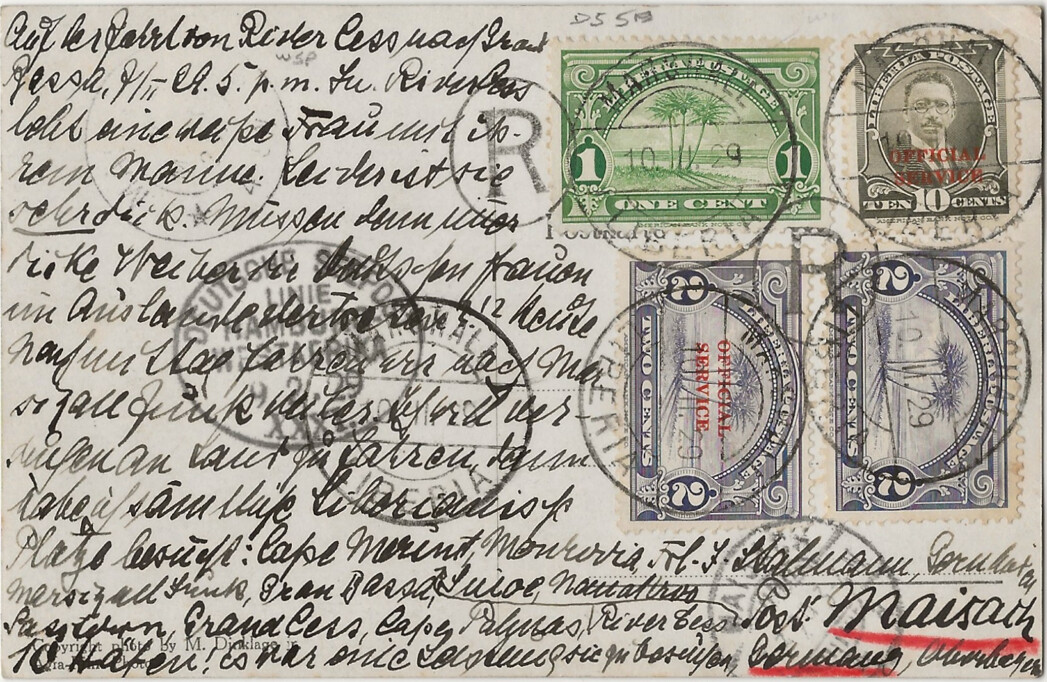
Transcript
Auf der Fahrt von River Cess nach Grand
Cess, 7/II-29. 5 p.m. In River Cess
lebt eine weiße Frau mit ih-
rem Manne. Leider ist sie
sehr dick. Müssen denn immer
dicke Weiber die deutschen Frauen
im Auslande vertreten?!? Heute
nachmittag fahren wir nach Mar-
schall Junk weiter. Ich will ver-
suchen an Land zu fahren, dann
habe ich sämtliche liberianische
Plätze besucht: Cape Mount, Monrovia,
Marschall Junk, Gran Bassa, Sinoe, Nanakroo,
Sasstown, Grand Cess, Cape Palmas, River Cess.
10 Häfen! Es war eine Leistung sie zu besuchen.
Translation
On the journey from River Cess to Grand Cess, 7 February 1929, 5 p.m.A white woman lives in River Cess with her husband. Unfortunately, she is very fat. Do fat women always have to represent German women abroad?!? This afternoon we’ll proceed to Marshall Junk. I will try to go ashore, then I’ll have visited all the Liberian places: Cape Mount, Monrovia, Marshall Junk, Gran Bassa, Sinoe, Nanakroo, Sasstown, Grand Cess, Cape Palmas, River Cess. 10 ports! It was an achievement to visit them.
Grand Bassa — 8 February 1929
Photo of Franke’s house in Gernlinden, used as picture postcard postmarked SEEPOST 9 February 1929, franked with Liberian stamps (16 cents) cancelled and registered 10 February in Marshall, arrived 7 March in Maisach.

Transcript
Grand Bassa 8/II-29.
Als ich gestern von
River Cess zurück-
kam, hatte ich wie
jedesmal keinen trok-
kenen Faden am Körper.
Ich habe sofort ein kaltes (?!) Bad ge-
nommen. Es ist doch schöner in Gern-
linden mit seinen 4 Jahreszeiten.
Ich sitze wie immer vor meinem
Ventilator u. denke an den schö-
nen Schnee Deutschlands. Aber kal-
tes Faßbier haben wir
auch an Bord. Ich trinke
auf Ihr Wohl. Franke
Translation
Grand Bassa, 8 February 1929.When I returned from River Cess yesterday, I didn’t have a dry thread on my body, as always. I immediately took a cold (?!) bath. It is nicer in Gernlinden with its four seasons, after all. I am sitting in front of my fan, as always, thinking about the beautiful snow in Germany. But we also have cold draught beer on board. I drink to your health. Franke